
A New King of the G5
Where might the next Byrum Brown be? Maybe playing for Marshall...

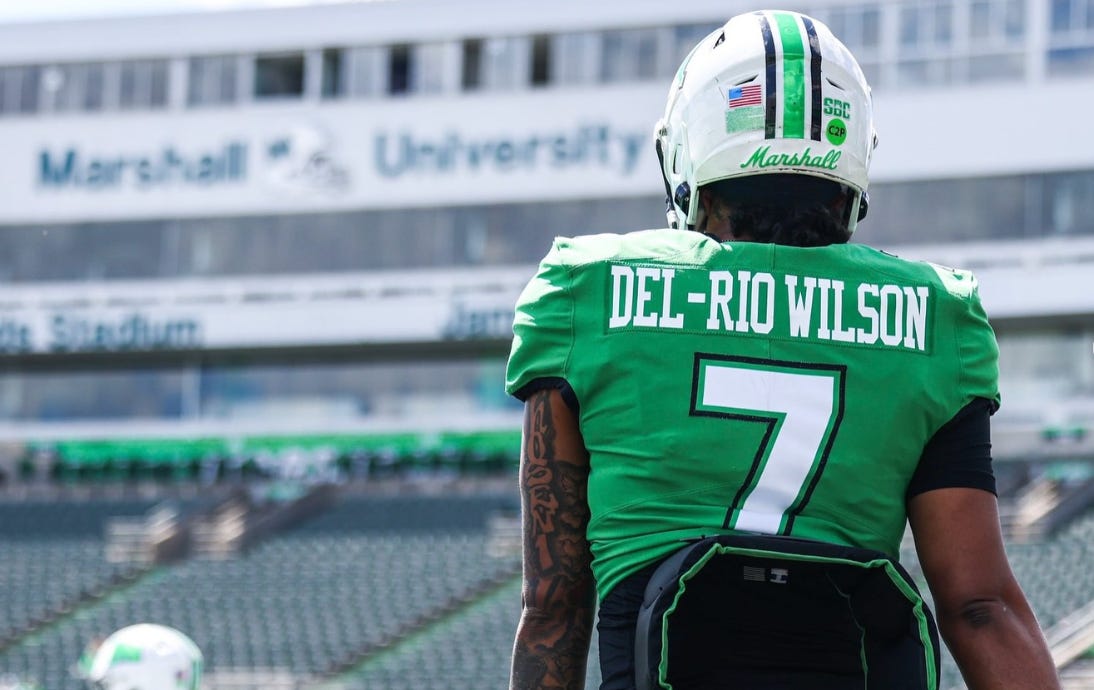
A crown is a pitiless master, harsher than the staff of a pig-keeper; while a staff bears up, a crown weighs down, beyond the strength of any man to wear it lightly.
- Lloyd Alexander, The High King
Few were fortunate enough to roster both USF QB Byrum Brown and the topic of today’s article—Marshall QB Carlos Del Rio Wilson—in the same league last fall. Luckily for me, I found myself among that select group in 2025.
The results were spectacular. Though, unlike Brown, Del Rio Wilson’s performance was quite inconsistent. There was a brief moment in early October where I pondered that I might have had the two best CFF QBs rostered on the same damn team within the Golden Pig Invitational (GPI) league. Turns out I was only half right.
In his first four starts, Del Rio Wilson accounted for 15 total TDs, and zero turnovers. During that span, in the GPI’s five point passing TD format, Wilson accounted for scores of 26, 38, 33, and 40 points. And the sole reason he only scored 26 vs. EKU was because he was pulled early in a blowout.
However, following that excellent run of four games was a stretch of six games where he only managed to score 25+ points once, a 37 point output vs. Georgia State.
The inconsistency was not something I could easily countenance. I didn’t mind so much in the GPI given it was a bestball scoring format with unlimited QB roster spots, but in a standard league this type of oscillation would render him virtually unplayable.
It might not have exactly been completely his fault. Indeed, there is a catch twenty-two with running QBs in that they often do get nicked-up throughout the season, and I believe that is what occurred with Wilson. His performance on October 11th vs. ODU, who were regarded as having one of the best defences in CFB, not just the G5 (held IU to 27 points), was one of the best individual performances I witnessed all year.
He produced an incredible amount of output—eviscerating ODU in the process—in a matchup that Marshall wasn’t even supposed to win. He was also on the receiving end of a lot of violence. And the coaching staff kept him in well past the point of necessity (a good sign for CFF, maybe not so good in real terms).
That staff returns, and so does Wilson for another year of carnage in Huntington, WV. Which is great news in my mind because a full offseason with Wilson taking starter snaps should directly address some of the problems that led to inconsistent output in 2025.
At the same time, last year’s King of the G5 (as I call him), USF QB Byrum Brown, no longer resides within the Group of Five. So there is an obvious void here not only within real CFB, but within CFF drafters’ rankings headed into 2026.
Could there be another Byrum Brown-esque commodity in 2026? Wilson presents a good case given his skillset. However, part of the magic sauce in Tampa was the pace of play. Former head coach Alex Golesh had the Bulls ranked in the top three teams on a seconds per play basis for the last three years. For context, Marshall were 52nd in 2024 (we will discuss this more in the next section).
So maybe there won’t quite be another player averaging 35+ PPG in 2026 (or at least, maybe it won’t be Wilson), but the path to a more reasonable 30+ PPG is not hard to imagine given the body of work in 2025. We know that the highs are very high with Wilson, and that’s half the battle when looking for CFF relevant QBs.
In fact, I think there are similarities between Byrum Brown’s 2024 season and Wilson’s 2025, in that both players played through injury and didn’t finish with the PPG they probably should have. Brown averaged an eye-watering 18 PPG in the five games he played in 2024. Wilson had a better 23 PPG average in the 11 he played in 2025.
The thing that separated Brown for me last year, even coming off a down year, was that the system he played in is fantastic for facilitating elite QB production, due to the amount of easy completions game-planned in and the pace of play calling. The system plus Brown’s skillset against G5 comp made possibly the highest upside profile I’ve ever come across in my time doing CFF.
I don’t see Wilson’s upside reaching the same heights as Brown’s due to the system, but I do believe that his floor can level out more in 2026 with some fortunate injury luck, which would likely result in him being one of the highest scoring, if not the highest scoring QB by the end of 2026.
COACHING & SYSTEM
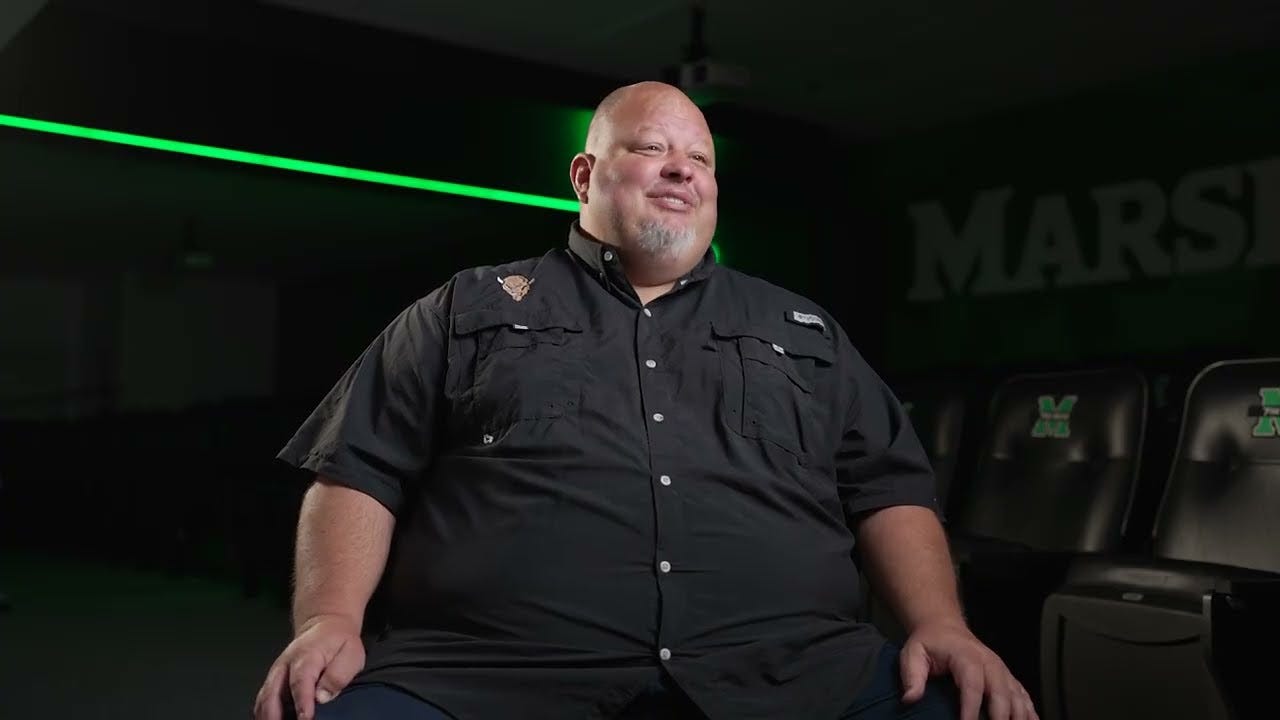
I want to be careful with the messaging here and note that while I don’t think the Tony Gibson-Rod Smith system is as good as Alex Golesh’s, that doesn’t mean it is a bad system.
On the contrary. The OC, Rod Smith, has been something of a magician in extracting value out of dual threat QBs, going back to his days of yore at Jacksonville State. In fact, multiple Smith-led offences have seen the QB finish as the lead rusher.
Some of you may remember former Gamecock pivot Tyler Huff, who finished with 1344 rush yards and 15 rushing TDs in 2024. He wasn’t quite the lead rusher in yardage, but he was not far off. Arizona’s Khalil Tate was another one of Rod Smith’s proteges, rushing for 1411 rushing yards and 12 scores on 153 carries in 2017. He led the team in rushing that year, as did his predecessor, Brandon Dawkins in 2016.
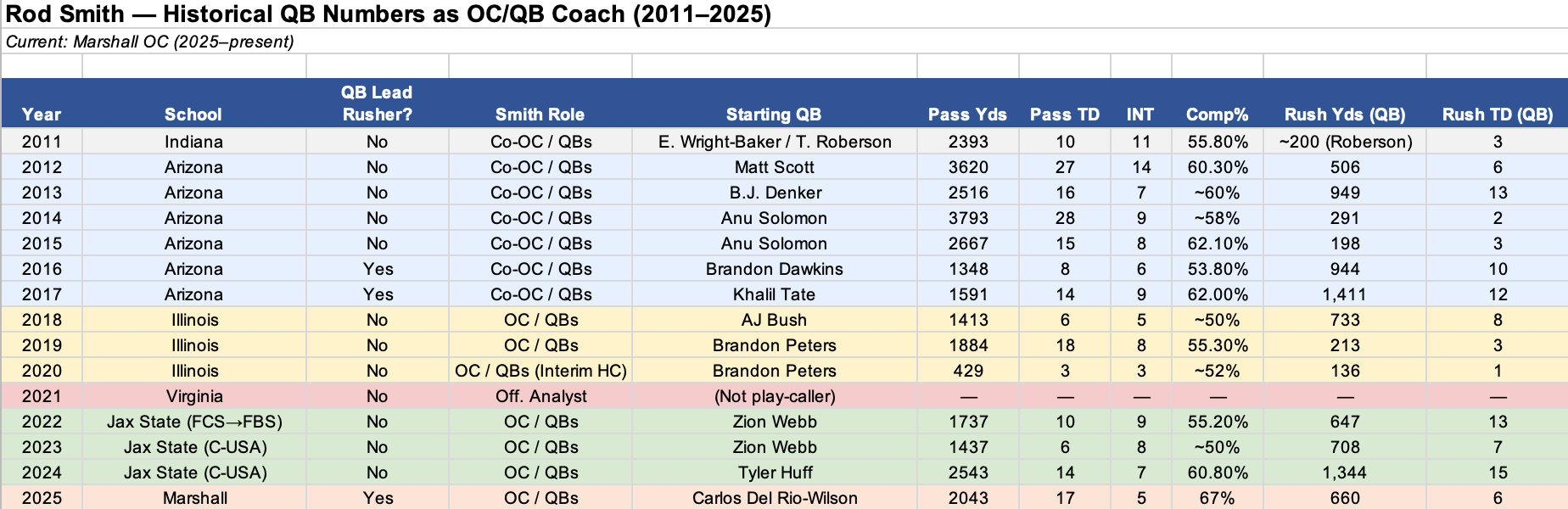
You might have thought that B.J. Denker led the Wildcats in rushing in 2013 as well, but it was actually legendary RB Ka’Deem Carey, who received a porcine workload of 349 carries to Denker’s measly 181. He out-ran the QB 1885 yards to 949. Still, that is another good rushing QB season in Smith’s inventory as far as I’m concerned.
Not captured in the table is Smith’s only other stint as a play caller—a brief time spent as the OC at, ironically, USF in 2005 and 2006. In ‘06, his QB, Matt Grothe, led the team in rushing with 622 yards and nine scores on 178 attempts. The ‘05 team was led by the RB (who saw 270 carries), and the QB scored four rushing TDs and accumulated 336 yards.
Beyond his impact as a play caller, some of the players Smith has helped develop as a QBs coach include: Denard Robinson (Michigan) and Pat White (WVU), two of the most dangerous rushing QBs in CFB history.
Obviously, this is a man who wants his QB to run the ball. That wasn’t really ever in question anyways given that Wilson is returning and he demonstrated a strong proclivity to carry the rock when healthy, but it’s good to confirm there is an emphasis from the staff too.
As far as Smith’s other play calling tendencies, his offensive average between 2018 and 2024 is approximately 64% run plays to 36% pass. But here is where things get interesting, and where you truffle pigs who are still reading this far may be rewarded.
I spent some time in the previous section explaining that Golesh’s system created a higher ceiling for Byrum Brown due to how many plays they could run in a short amount of time; and that with Wilson, Marshall moved slower. It is true that in 2025, the Thundering Herd moved too slow to be compared to an Alex Golesh-USF offence, but historically speaking, Rod Smith’s offences move very fast as well.

In 2023, Jacksonville State was actually the only FBS team that moved faster than USF with an average of 20.3 seconds per play. The previous year wasn’t quite as torrid, but 22 seconds per play would have still landed them comfortably in the top 15 of FBS programs had they already moved up.
And in 2024, not included in the table, JSU finished 11th in the FBS with an average of 23.2 seconds per play. This changes the narrative regarding Wilson in my mind. Even if he profiled as a mere simulacrum of Brown, he was an interesting player. But the fact that most, if not all, of the same characteristics that made Brown exciting in 2025 could also be present here pushes Wilson into a similar valuation in 2026 for me (I believe I had Brown rated a top-15 QB in my last 2025 rankings).
I’ve yet to compile any rankings of players as of writing this, so I don’t know exactly where I’d place Wilson. I’ll have to evaluate the rest of the group first before putting a number on him.
The head coach is Tony Gibson, whose background is on defence, so there’s no need to delve into his history.
SUPPORTING CAST
Another piece of the puzzle in all this is the supporting cast. According to Dawgstats.com, Marshall are 63rd in the FBS in returning OL snaps. They also return RB JoShon Barbie and WR Adrian Norton, who were among their leaders in rushing and receiving last year. Starting TE Toby Payne (37-393-3) returns as well.
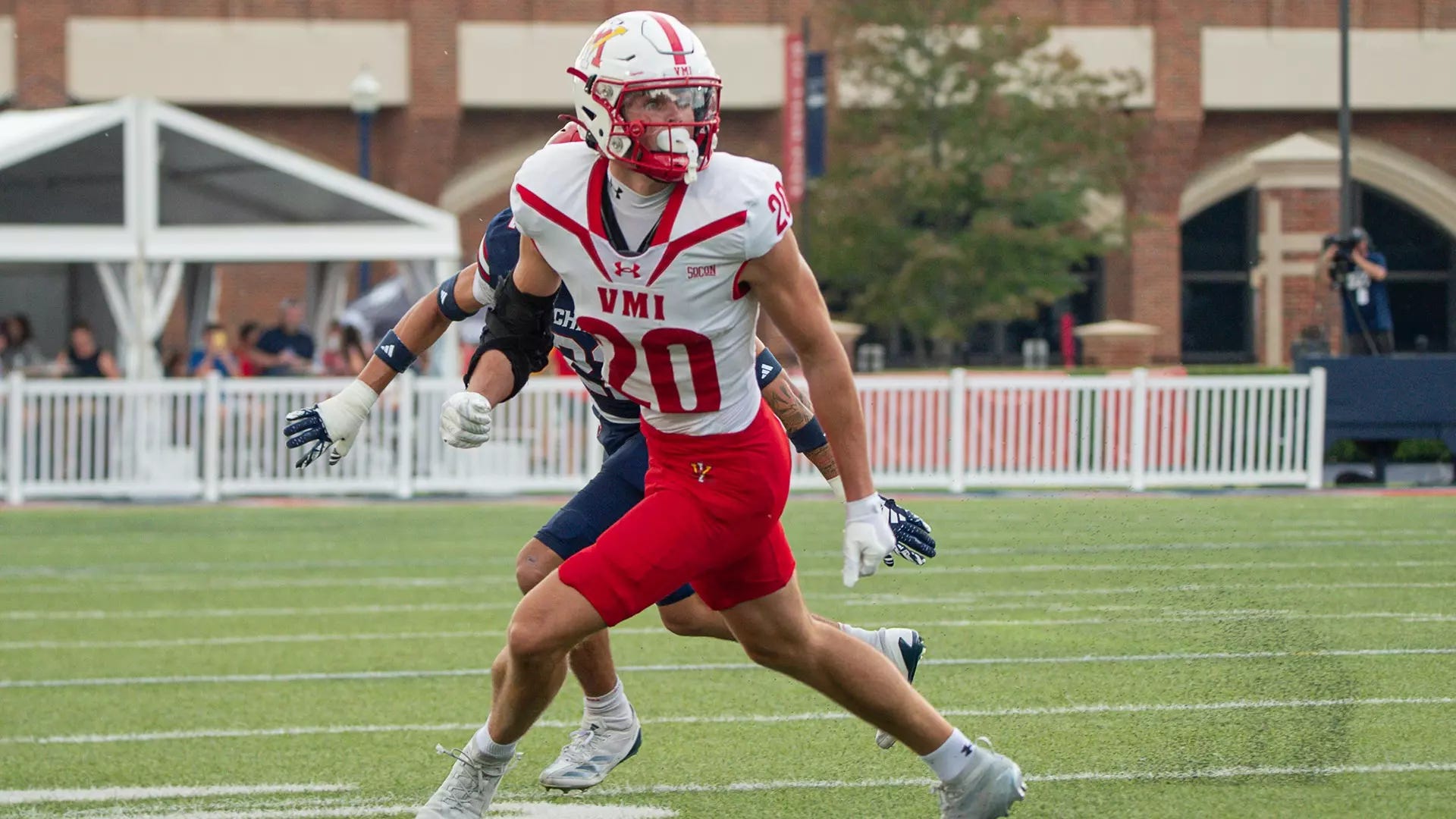
New additions include WR Owen Sweeney (6’4, 200), who caught 44 passes for 723 yards and seven scores in 2025 with VMI (FCS). He’s a big-frame guy who’s going to compete for snaps on the outside.
Kentucky’s Jamarion Wilcox transferred in at RB. He immediately becomes an interesting name given that Rod Smith has had the occasional porcine bellcow via Tre Stewart (JSU), Ka’Deem Carey (AU), Nick Wilson (AU) and Andre Hall (USF). TJ Lester is another transfer incoming at RB from FCS school West Georgia.
Overall, I think the pieces around Wilson are sufficient for another strong offensive season (health willing). The two main questions determining Wilson’s ceiling will be his durability, and the pace of play for 2026.
At best he could end up being the highest scoring player in CFF 2026, at worst, he’s another footnote in a long list of frustrating QBs who are better bestball assets than standard. Here’s hoping for the former. ◾
If you enjoyed this content and would like to read more, I recommend joining the Pigpen, a community of thousands of degenerate college football fans:
Headed into next year with CDRW, Demond Williams, Colandrea, and Colton Joseph at QB. Probably not keeping Colandrea and Joseph with their gross G5 to P4 transfers to Nebraska and Wisconsin, respectively. Also, 6pt PTD scoring so not very interested in these Big 10 offenses… 🤮