
Apotheosis


All men's souls are immortal, but the souls of the righteous are immortal and divine.
- Plato, philosopher
“Apotheosis”—from the Greek word apotheoun, meaning to deify or make a god—refers to the elevation of a person to divine status.
In antiquity, it was reserved for emperors and heroes whose deeds were deemed so extraordinary that mortal classification no longer sufficed. The Romans practiced it formally; upon death, a sufficiently revered Caesar would be declared divus, ascending from man to god by senatorial decree.
The concept has since transcended its classical origins, finding its way into art, literature, and the broader lexicon as a shorthand to describe the ne plus ultra of something—think Derrick Henry toting the rock 46 f—ing times against Auburn in 2015. It is in that spirit that we turn our attention to a player who currently resides within the US Army Academy.
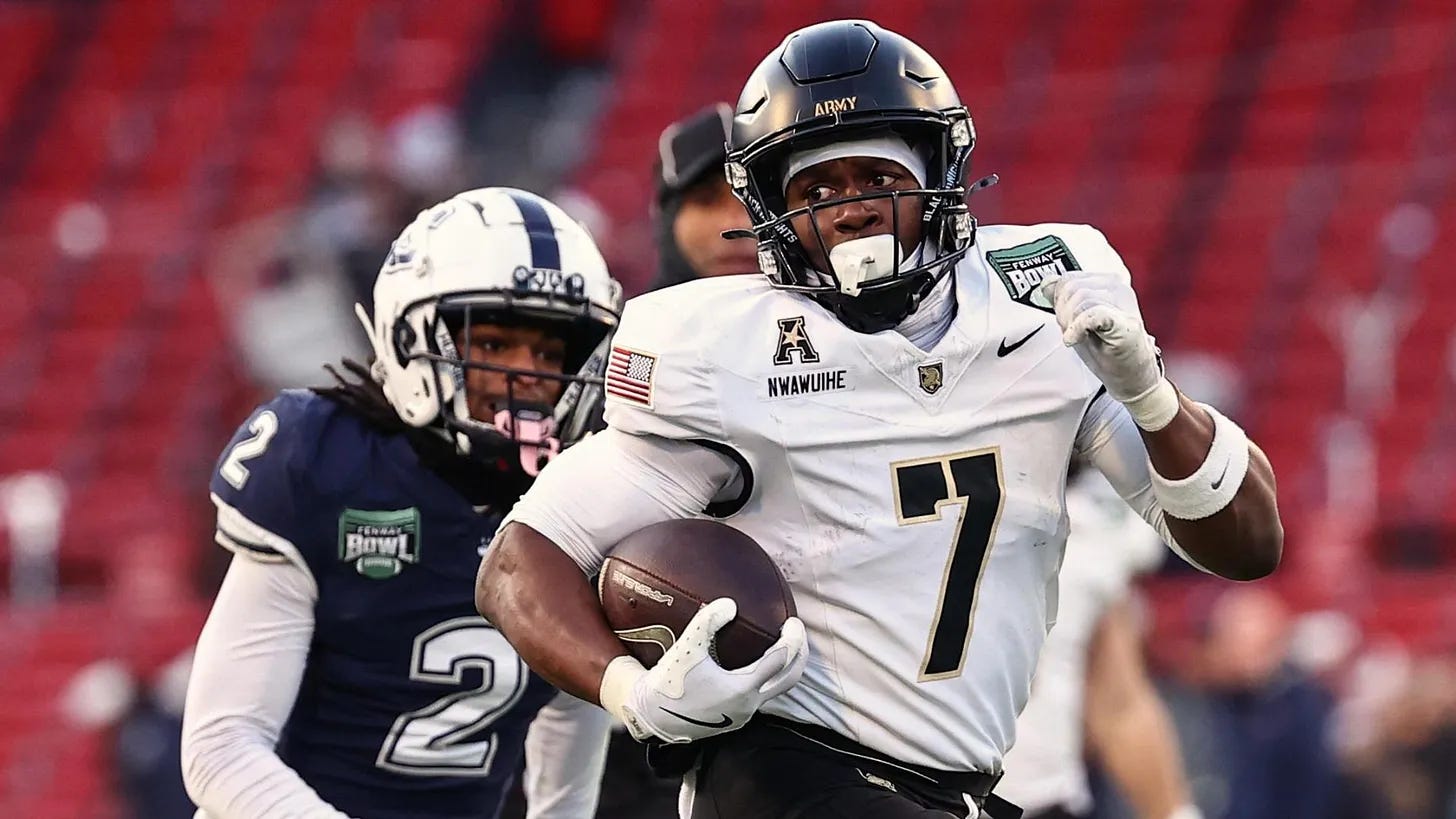
Godspower Nwawuihe—who if you can pronounce his last name confidently perhaps you too are a deified being—made himself known to the CFF community writ large during a bowl game vs. UConn last December.
During this contest, Godspower, who I’m going to refer to as ‘GN’ from here on out, took only 12 carries to light off 171 yards and two scores in what amounted to a potent opening salvo for his career. Now, it should also be noted that he was a true freshman last season when the game in question occurred, and was actually recruited as a QB prospect and converted to RB in September last fall, making this feat even more impressive. At least, I think so.
And lucky for him, he only appeared in four games, preserving his redshirt, meaning he still has four full seasons left to play if he wants them.
One criticism the detractors may have with this particular player is that with Army, the primary RB is really the QB, thus the player listed as 'RB' often has his relevance abrogated from a CFF standpoint. This is more or less true, but there was one exception in Kanye Udoh, who spearheaded a dynamic running attack in 2024 with Bryson Daily at QB.
Point being, it can be done if the right player is back there. Cale Hellums is the presumed starter for 2026 at QB, and he’s of course an able-runner. But he isn’t quite as great as Daily was, not yet at least, and so there will be an opportunity for a RB to step up if they are able.
This brings me back to GN, who had a breakout vs. UConn at the end of last year. It’s important not to take one game too seriously, especially in the absence of any other meaningful data points. But from my view, the most impressive thing about the performance was that this was a true freshman player who had barely played all year, and who looked as if he were a literal Greek God on the field.
Though, to be precise, he is only listed at 5’10, 210 pounds. Nothing overly dramatic, but it is one of my favourite height-weight specifications as it has a tendency to appear frequently when looking at past CFF demons. In fact, at one point in my life I actually referred to this spec as the demon build, which I might just have to bring back for the purposes of these articles. For a moment in CFF it felt like every RB who was killing it wore this height-weight combination.
It’s also probably generally just a clean height and weight to list for most players, especially when rounding up (which seems to happen a lot), so it has a tendency to appear frequently regardless. Still, I like the idea of the demon build, so I’m rolling with it.
Why Army is Generally Not a Good Place To Look For RB Value
What Army has been utilizing on offence since head coach Jeff Monken’s arrival is a modified version of the triple option. This shouldn’t be news to most of you—each of the service academies deploys their own strand of the triple option scheme.
You should also be aware that these teams are extremely run-heavy, so why wouldn’t the RB be a good position to invest in as a prospecting CFF manager?
First, the system actually utilizes multiple runners on the field a lot of the time (it’s not just the QB and RB out there like most teams). Second, as alluded to earlier, the QB is oftentimes the primary runner and will be the chess piece utilized most frequently in the redzone (the ‘triple’ in the name means the QB has three options each play: hand off, keep, or pitch, which also alludes to multiple runners being on the field besides the QB). Thirdly, although I don’t think this factor is as important, these teams tend to move very slowly, and not score a lot of points (well, until recently, at least).
Ground and pound, clock management, and a wide distribution of touches has sort of been the name of the game for service academies throughout their existence.
Obviously, things have changed a little bit over the past two seasons, where not only one, but all three service academies have had some absolutely lights-out CFF assets. One of those assets actually being a former Army RB in the aforementioned Udoh. So we know something good can happen here because there is a proof of concept.
Though Army is a bit unique out of the three. Air Force and Navy utilize RBs and FBs, whereas the Knights deploy RBs and something called a ‘slot back’ denoted as SB, which are actually lighter players who catch passes too. So the RBs are the bigger entities in their triple option triangle, whereas these guys are smaller in AF and Navy’s. So the RBs may have more blocking responsibilities at Army but that’s just me speculating.
And if you’re seeking some evidence to verify the claim that these are slow moving programs, according to Teamrankings.com, Army, Navy, and Air Force ranked 136, 132, and 124th in seconds per play last season, respectively. So Army was literally dead last, and Navy was not far behind.
Interestingly though when I look at actual plays run per game, Army is tied at 97th, and Air Force was all the way at 51st despite ranking 124th in seconds per play!
97th is still not good for Army, but it was noteworthy considering it’s significantly higher than I expected given their 136th seconds per play data. This can be interpreted as Army moving very slowly, but sustaining a lot of long drives throughout games, thus allowing them to run a solid chunk of their offence each week.
And perhaps while we’re on the subject this is a good opportunity to point out the limitations of seconds per play/plays per game data. It’s a good measure of teams that want to move fast, but in some cases, teams are just going three-and-out a lot and not sustaining drives. So even though they waste little time in getting to the line of scrimmage, the actual volume of plays they run per game is not impressive.
Army, and especially Air Force, were on the opposite end of this spectrum last season. These teams did not move with urgency, but they did manage to stay on the field for long stretches at a time, allowing them to run more plays than you might have expected on the surface.
Still, I maintain that generally speaking the teams that move the fastest will run the most plays, and these will be, on average, offences that are more desirable from a CFF standpoint. Like with anything, there are exceptions.
Analyzing the Depth Chart
There’s a few things that have to happen before I cosign Mr. Godspower, or GN, as I refer to him above. The first thing already happened: he received RB eligibility on fantrax. Check that box off.
The second is regarding the depth chart. Army is an arcane place to get intel out of, so perhaps this is wishful thinking on my part. But it would be great if we could get some colour on the expected rotation this upcoming fall. Other players in the room include Jake Rendina and Briggs Bartosh, who have each played a solid chunk of snaps so far in their careers.
Rendina, in particular, is a big player, listed at 240 pounds and five feet eleven inches tall. I can see a power formation with him as the blocking back and GN as the runner, but perhaps that’s just me letting my imagination get away from me.
At current juncture, we have no idea what the plan will be from the Army staff. And the list of players they have at RB/SB seemingly grows out of thin air every time I check back—here’s a screenshot from Rotowire:
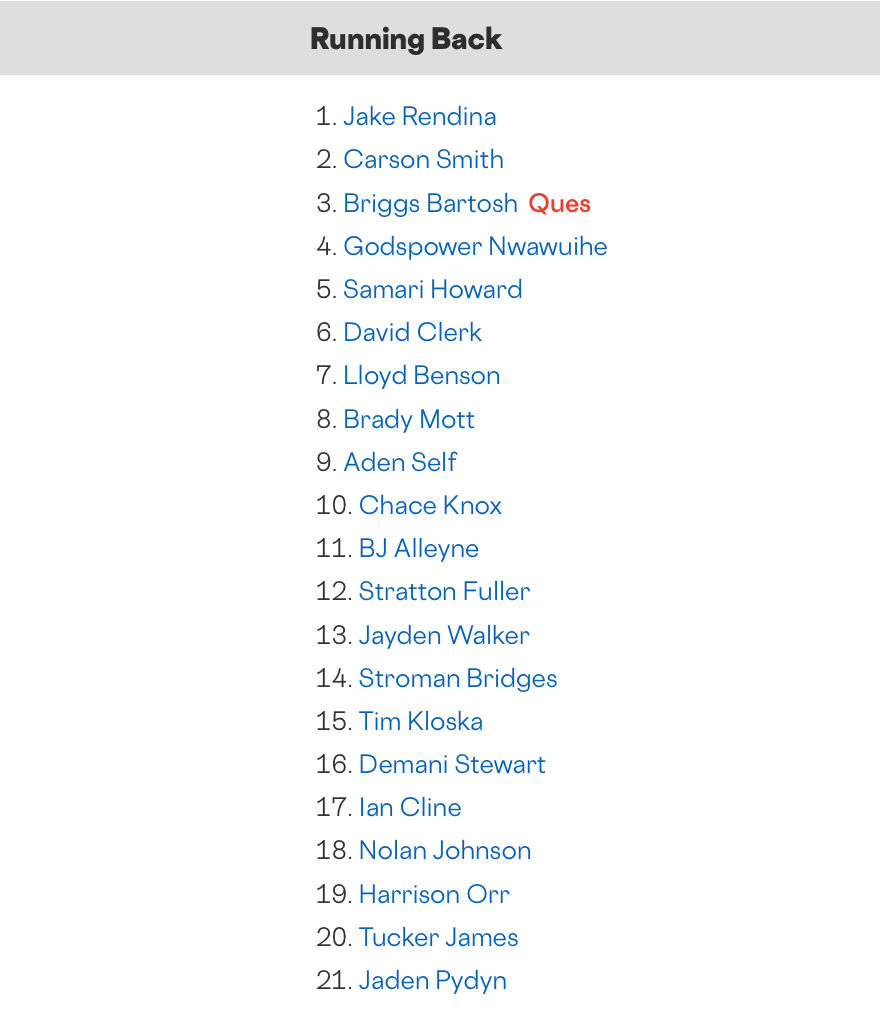
Lol, I mean… what do we even do with this? This is a quarter of the roster.
When I look back at GN’s breakout performance, six players handled carries for the Knights in that game: Hellums led the way with 15, then Rendina at 14, GN at 12, Carson Smith at nine, and the other two players are no longer with the roster (Noah Short, 5, DeWayne Coleman, 1).
That rotation is confidence inspiring for me. If that just repeats itself 12 times next season I think good things will happen. I can imagine a scenario where GN is the second or third leader in carries each game, and if he can average 10-15 per appearance—and if the UConn performance is any indication—he could find himself being a fairly productive player in 2026.
And I know, I know, so many ‘ifs’ in there this is just wonky speculation at this point. Well, there’s a reason players go undrafted currently, and not all of these players are going to be irrelevant in the game of CFF. Maybe GN starts creeping into later rounds of bestball drafts as the offseason unfolds now that he has RB eligibility. Even so, I think he’s worth taking a few shots on.
This profile is exactly what late round picks are made for if you ask me. The back end of CFF drafts is not the time for tepid imaginations nor anodyne selections. This is the time to take swings. True, there’s a high chance that he just ends up not starting and doing virtually nothing in 2026, but also a slim chance that he becomes a great CFF asset to hold; profiling as a worthy late-round gem.◾
If you enjoyed this content and would like to read more, I recommend joining the Pigpen, a community of thousands of degenerate college football fans: