
"BABY BROCK" The Highest Paid TE (Probably) in CFB History
Meet USC freshman Mark Bowman

When I was sixteen I bought my first Mercedes-Benz, I must’ve fucked a thousand bitches and they girlfriends.
- Lil Wayne, musician
I wish I could go back in a time machine to college football in 2021. In hindsight, it feels to me like one of the last great seasons in the old, pre-NIL era of CFB. While NIL payments technically went live that summer, it was still a new mechanism that was in its infancy; furthermore, the transfer portal was also not as prominent in the sport.
Most teams were predominantly comprised of their high school recruits, with a few outliers like Ole Miss and Alabama filling in important gaps on their rosters with star players from elsewhere.
The season kicked off on a Thursday as usual, with the highlight of the weekend culminating in a top-five Saturday night showdown between Georgia and Clemson. This was a star-studded affair, particularly on the Georgia side, which, in hindsight, has an argument for being the most talented roster of all time based on NFL draft production.
The highest rated TE prospect ever in the modern recruiting era, Arik Gilbert, was one of three transfers brought in by UGA head coach Kirby Smart in the offseason. Much was expected of him on arrival, but he ended up stepping away from the team before the season kicked off.
Instead, it was a lesser-known four star, Brock Bowers, who had come in that offseason as a freshman from Napa Valley, California, who ended up stealing the show.
And sure, the game was largely a defensive affair (the final score was 10-3), but a freshman TE topping all receivers with six catches and leading UGA with 43 yards was impressive (especially against a Clemson defence) and indeed proved to be a harbinger of things to come throughout his career.
Bowers finished his days in college as perhaps the greatest collegiate TE of all time. Not surprising then that a future generation of TEs idolized him—class of 2026’s Mark Bowman was no exception.
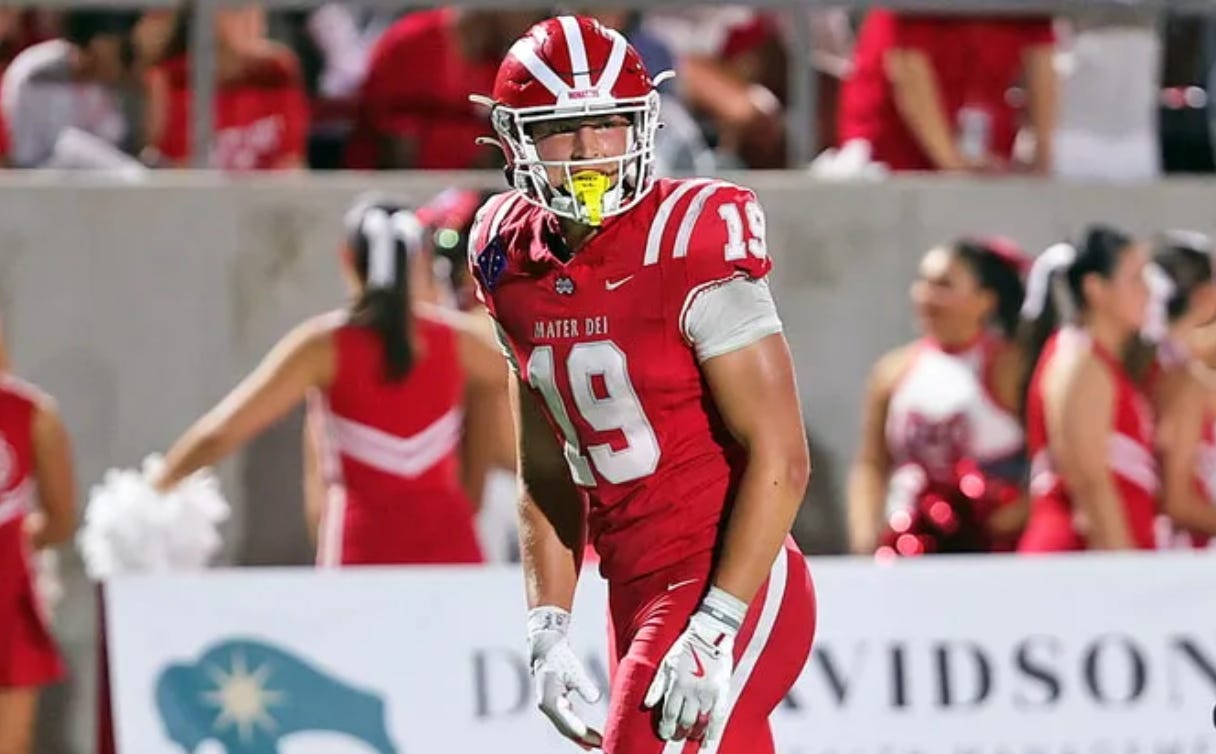
Originally a C/O 2027 prospect, the five-star Bowman hailing from Southern California reclassified to 2026 and signed with the nearby Trojans. As a prep player, he was a star at Los Angeles powerhouse Mater Dei, where he donned the #19 jersey in honour of his idol. Those who have seen his highlights can confirm that the two players look quite similar. In fact, Bowman’s nickname in high school was “Baby Brock”.
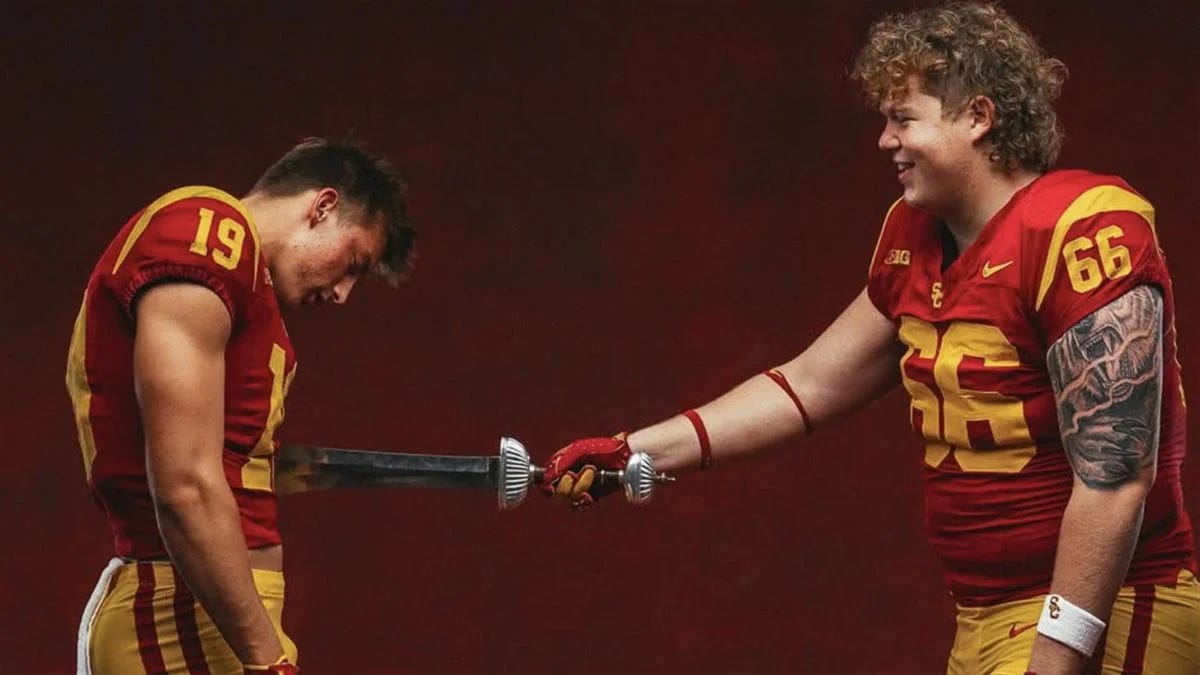
While UGA was an early favourite for his services, Bowman ended up being one of the most highly contested recruits in the C/O 2026, reportedly resulting in a very lucrative bidding war between USC, Texas, and eventually with LSU making a late push on signing day to flip Bowman away from the Trojans.
There have been rumours reporting figures of $5-6.5 million across a three year period for Bowman’s NIL deal out of high school. Considering most of the high end QBs coming out of HS will receive meager deals of around $1-2M, Bowman’s deal is an unprecedented one, especially for TEs.
One can only imagine what a player like Bowers would have commanded in today’s NIL market, and it seems that USC is banking on Bowman’s resemblance to the former UGA great extending beyond his jersey number with his play on the field.
I suppose we’ll see how it works out for them. At the very least, the investment signals intent to want to feature this player if he lives up to the hype. My first question with respect to CFF analysis is: does Lincoln Riley’s have a good system for TE production?
COACHING & SYSTEM
TE1 PPG AVERAGE — HC: 6.0 (1PPR)
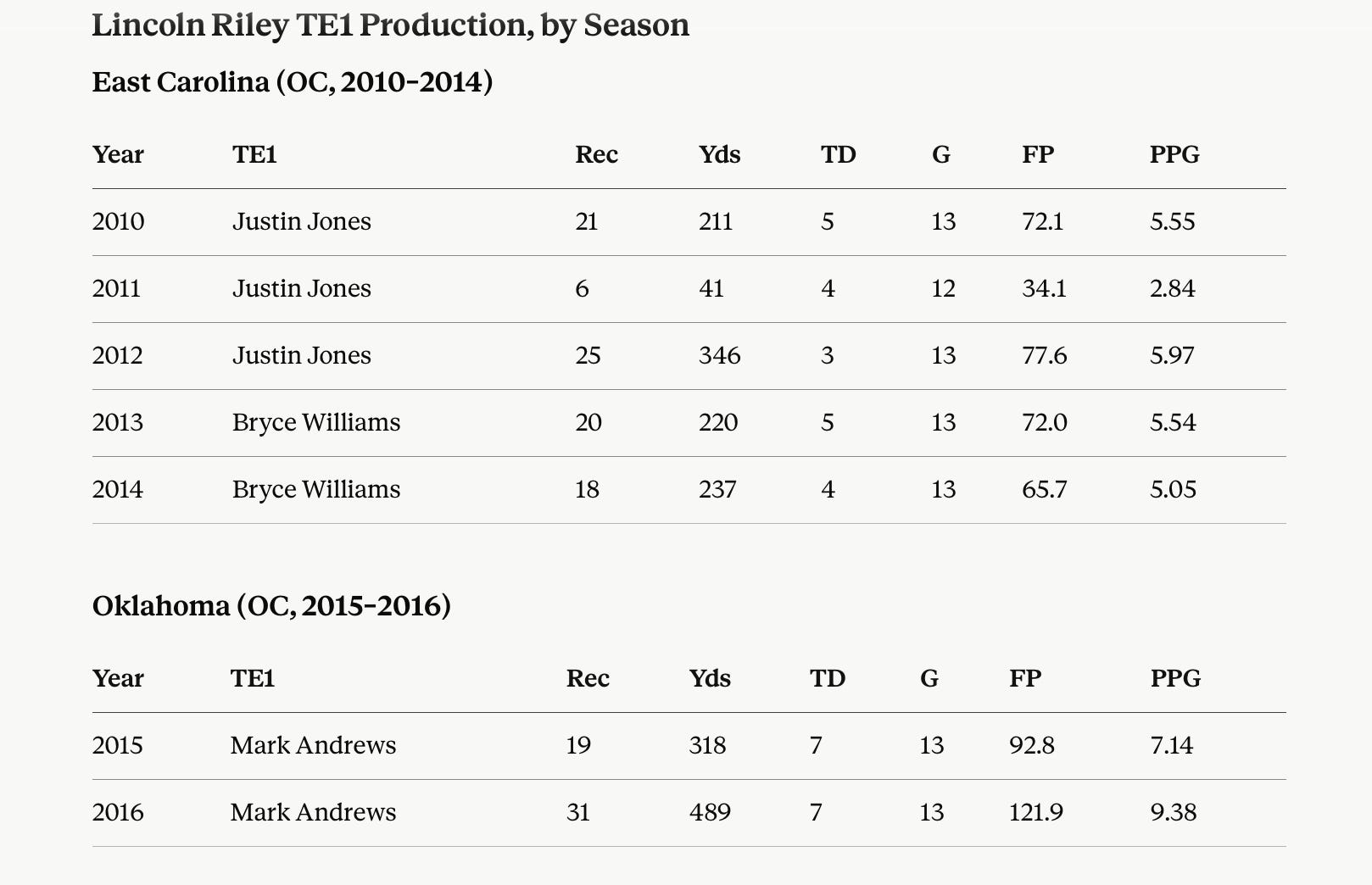
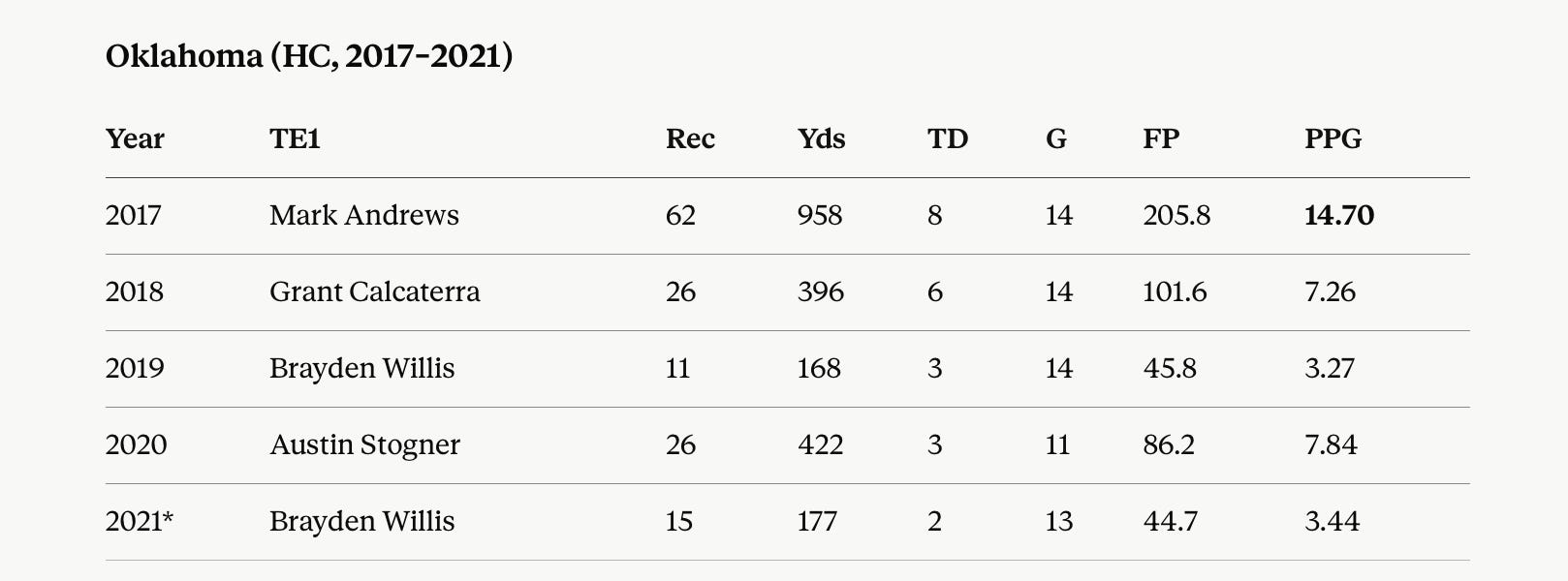
The short answer is no. However, ‘TE systems’ aren’t really a thing in CFB. There aren’t really many, if any, coaches who actually have a TE1 PPG average in double digits; thus, simply due to the fact that Riley has a TE in his repertoire who averaged 14.7 PPG (Mark Andrews, OU, 2017) makes him notable in my opinion.
There have been a few other solid performances like Andrews’ 2016 season (9.3 PPG), Austin Stogner averaging 7.8 in 2020 and Grant Calcaterra with ~7 PPG in 2018. You can find Riley’s full history of TEs each season that he’s been an OC or head coach below:
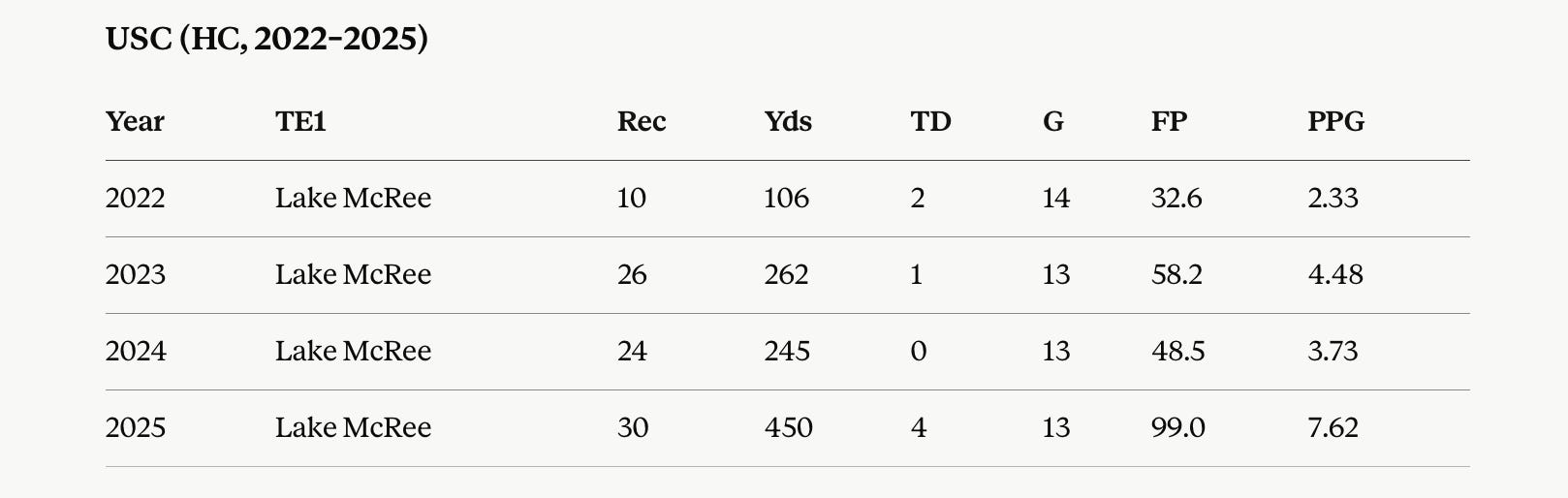
And while you might have expected Riley’s play calling skew to average towards the pass, his five year average is actually almost 50/50 run-pass. His offences are also not particularly quick with a 26 second per play average, or around 67 plays run per game.
What is working in our (and Bowman’s) favours here is that USC returns QB Jayden Maiva, but none of his top WRs from a year ago. That in conjunction with 2025’s starting TE moving on (Lake McRee) and there is an interesting recipe brewing here for a potential Mark Andrews/Brock Bowers 2.0 under Riley.
Hell, even if Bowman manages to win the starting role and finish the year with around a seven PPG average that would be notable in my mind, and it would likely result in him being one of the top TEs drafted in 2027 CFF leagues.
So how is it going so far for the true freshman? Here is an article back in April quoting his position coach, and covering the TE’s progression through spring ball:
Bowman’s position coach is a no-nonsense, detail-oriented guy. Chad Savage was as excited as anyone else to get the 6-foot-4, 235-pounder in cardinal and gold this spring. However, he made it clear he wanted to work Bowman into a complete ballplayer before the offseason was finished. Like most freshmen, there was certainly an onboarding process of adjustment as he got his first taste of college ball.
“Those weeks after spring break, we talked about the transition for guys,” Savage said. “When they come in, the Ys and the Hs, those tight ends, we put a lot on their plate mentally. Because the guys, whether they’re tight end or whether a guy that we’re flexing out, and he’s got the ability to do both, and so he’s got a lot on his plate. There were just times where he was thinking about maybe his alignment, his assignment, but once he could think less and play faster, he was being the Mark Bowman that we know he’s capable of [being].”
Bowman made it clear during the individual periods we were able to observe as well as during the one full practice we watched he’s going to make plays as a receiver. He may already have some of the best hands on the team, and he moves fluidly in and out of routes standing up as a receiver. Savage and Bowman zeroed in on the crucial skill he’s going to need to stay on the field as an all-down tight end once USC starts playing conference opponents.
“From that position, you got to require being a willing blocker,” Savage said. “So obviously you got to be physical at the point of attack, because you’re going to go against some of these d-ends in the Big Ten.”
"He did take tremendous strides," Savage said. "Obviously, he's got the natural gift of being a willing blocker, plays compact, ability to unlock his hips, but just investing the time, he did a great job working with [assistant offensive line coach] Chris Meyers, who would go with those tight ends when they were going down with the o-line, doing some pod work.
TEs are sort of like RBs where the key piece of the puzzle—and often the missing link keeping young players off of the field—is the blocking ability. Making plays with the ball in his hands at this level shouldn’t be a huge learning curve for Bowman, who I believe was actually rated a five star player on all three major recruiting services.
Part of what made Brock Bowers otherworldly was that he arrived on day one as both an elite receiver of the football and an elite blocker. That is sort of unheard of in collegiate football. Long story short, Bowman probably won’t be another Brock Bowers, but there’s a lot going for him as a potential true freshman contributor in 2026. I’m keeping him in mind for the back ends of re-draft leagues, and I advise you to do the same. ◾
If you enjoyed this content and would like to read more, I recommend joining the Pigpen, a community of thousands of degenerate college football fans: