
Chang's Blueprint: Rinse & Repeat With Hawaii Transfer WR Audric Harris
Swap one Harris out for another, what do you get?

Hawaii’s the 50th state? I thought it was a suburb of Guam.
– Bobby Heenan, Wrestler
Last offseason the Hawaii Rainbows brought in what turned out to be one of the most underrated transfers of 2025. An unknown receiver who had a total of six catches in his first two years with Stanford was looking for a new home, and the Rainbows were in need of a playmaking partner to duo with Pofele Ashlock in the slot.
Understandably, a program like Hawaii doesn’t exactly get their first pick of who’s available. In this new world of collegiate football, NIL budgets reign supreme in determining the hierarchy of who gets matched up with whom in the transfer portal.
Which, in my opinion, makes following programs like Hawaii all the more interesting. Scouting and evaluating talent is still very much alive at the G5 level right now, basically by necessity in a sink-or-swim manner given that these organizations hemorrhage their top talent each offseason to the portal.
Long story short, you either identify players like Jackson Harris and swim, or you don’t and get fired.
Hence, here we are once again with another under-the-radar transfer headed to the islands this offseason. Former UW WR Audric Harris joins the program in a slightly better position than Jackson did—Audric has seven receptions over his first two years compared to Jackson’s six prior to last year. Similarly, Audric scored one TD in his first two seasons just like Jackson did with Stanford.
Audric is a near carbon copy frame-wise standing at 6 feet 1 inche tall and listed at 200 pounds. For reference, Jackson was listed at 6’2, 200.
So, on the face of things this move looks pretty uniform to the last one. The vision seems clear. We know Ashlock is good, but he’s never been great, and he appears to be better when he’s not the focal point of the offence.
Here is an excerpt from an article back in January when Audric committed to Hawaii:
Hawai’i added a big-play receiver threat to its offense with the addition of Harris. He played sparingly in 2025 for the Huskies. But when called upon, he had an immediate impact. Against Purdue, Harris had two catches for 90 yards, including a 61-yard touchdown reception. Harris finished his sophomore season with five catches for 99 yards and a score.
He was one of several talented receivers who had to fight for playing time in a deep receiver room at Washington. But at Hawai’i, he’ll have the opportunity to become a starter.
Harris will join his former high school quarterback Micah Alejado, who tossed 35 touchdowns his senior season at Bishop Gorman (Las Vegas). Harris hauled in 13 of those touchdowns with an average of 95.5 receiving yards per game during their final season.
His fit at Hawai’i is ideal. There’s already an established quarterback-receiver chemistry. And three of the team’s four leading receivers from last season will not be returning next season. Jackson Harris transferred to LSU with a team-high 963 yards and 12 touchdowns. Brandon White, the third-leading receiver, also entered the transfer portal. And Karsyn Pupunu is out of eligibility, but petitioning for an additional year due to a medical redshirt.
That leaves Pofele Ashlock, this year’s Hawaii Bowl MVP, who had eight touchdowns in 2025 with a team-high 79 catches. Harris will step foot on campus with a clear opportunity to reach the top of the depth chart for the Rainbow Warriors.
COACHING & SYSTEM: Run-N-Shoot
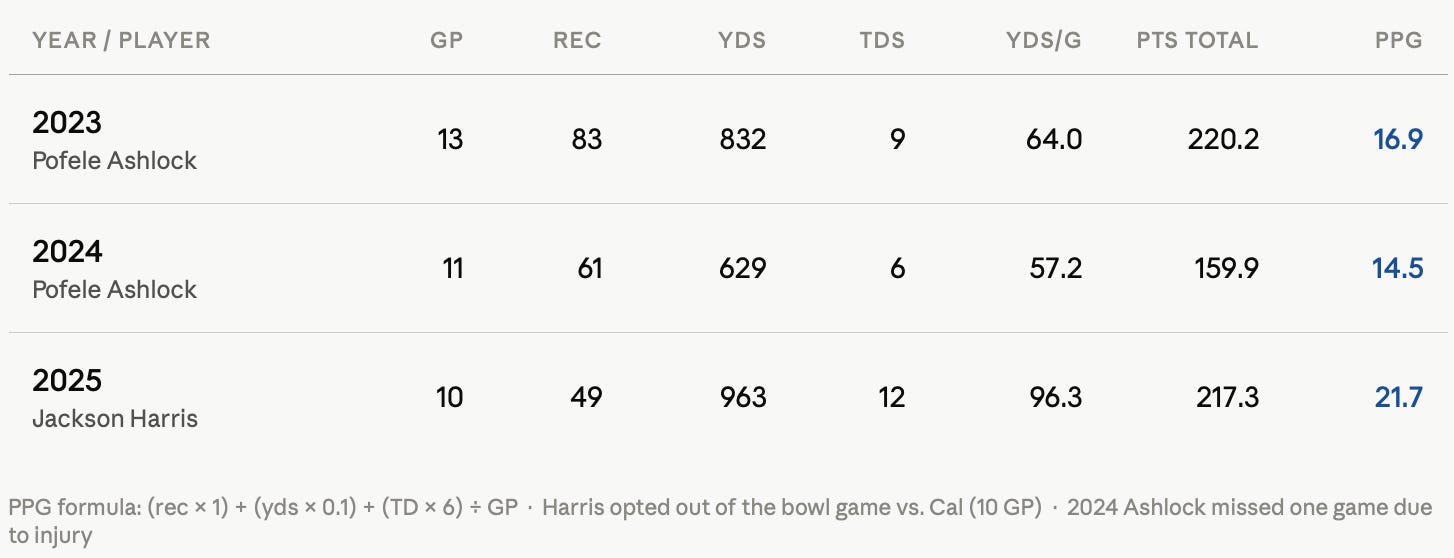
WR1 PPG AVERAGE — HC: 17.7
I’m going to reference an article I did last year on Hawaii’s offence, which is also referencing some info I included in an article I wrote back in 2023 focused on former Hawaii receiver Steven McBride and current player Pofele Ashlock:
There isn’t a lot of data on Chang because he hasn’t been a play caller for very long. But that doesn’t mean we don’t have an extended history to observe this system, which has been utilized at Hawaii under several different regimes over the past 25 years. Chang himself even played QB in this system in the 2000s.
In his first two seasons at Hawaii, Chang’s Rainbow Warriors skewed incredibly pass-heavy (62% in 2023, 58.5% in 2024). His starting QB averaged 40 or more passes per game each season, which is is not surprising given what we know of the Run-N-Shoot system, though you might have expected the pace of play calling to be faster than 67 plays per game through two seasons (which is toward the upper bound of the average range in the FBS).
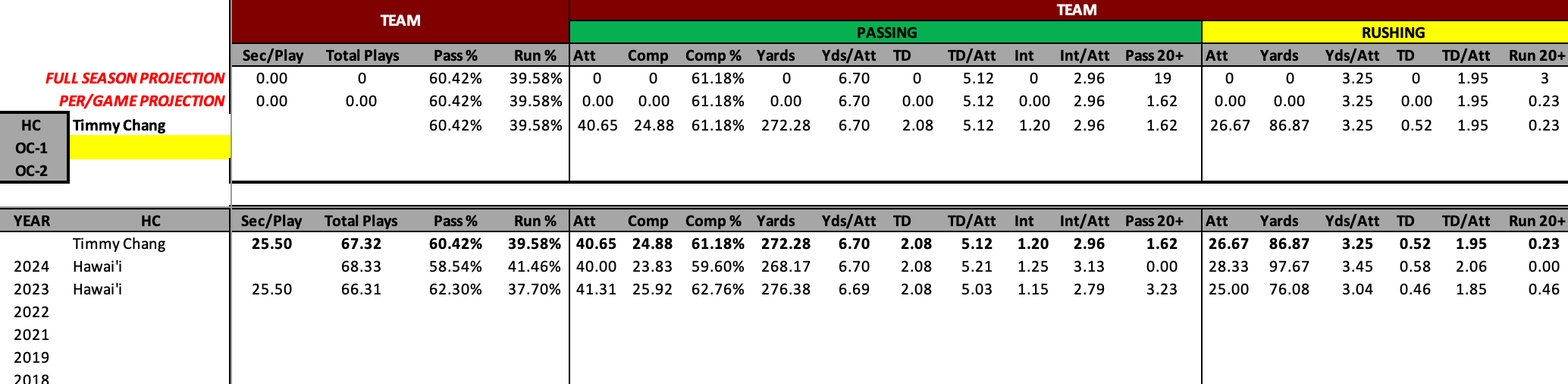
In terms of what the Run-N-Shoot actually is, I will link an excerpt from an article I did on Hawaii’s offensive system in 2023; if you don’t mind, I am going to save myself the trouble and copy-paste the relevant details here for you:
Everybody’s probably heard of the ‘Run-N-Shoot’ offence, but few among us actually know what that means. I consulted a trusted source (wikipedia) and found this: The run and shoot offence (also known as Run N’ Shoot) is an offensive system which emphasizes receiver motion and on-the-fly adjustments of receivers’ routes in response to different defences.
That doesn’t seem that crazy, but it is an offence that is synonymous with Hawaii football. Current Hawaii Head coach Timmy Chang actually ran this system as a player in the mid 2000s, and it’s been employed by various Rainbow coaches over the last 25 years.
As a coach, Chang joined Hawaii last season (2022), after spending five seasons in various capacities with Nevada (WRs coach 2021, 2017; TEs coach 2018-2020). He had the opportunity to call plays in his system as the OC of Div. II program Emory and Henry in 2016. That year, the Wasps had three separate WRs receive over 450 yards and five or more TDs.

Before that he spent two seasons as the OC at Jackson State (2014-15). Unfortunately, I was unable to find reliable stats for these two seasons.
So that’s basically Chang’s coaching career summarized (he got his start as a GA at SMU in 2012). It’s safe to say — despite its notoriety — he hasn’t actually had much success with this system as a coach (yet).
The Run-N-Shoot system itself, however, has shown to be a successful formula in the past for WR production in particular.
In Chang’s last season as the QB of Hawaii (2004), Chad “Mighty Mouse” Owens led the team with 102 receptions for 1290 yards and 17 TDs. The WR2 finished with a solid stat line as well, receiving over 970 yards on 80 catches and seven TDs. An interesting nugget: Owens had four TDs in a single game on two different occasions in 2004, and both times were vs. B1G opponents Northwestern and Michigan State.
In Chang’s sophomore season (2001), WR Ashley Lelie had the greatest year ever for a UH receiver, grabbing 84 receptions for 1,713 yards and 19 TDs. He set a school record for average receiving yards per game (142.8).
While former NFL’er Davone Bess was there (2005-07), he went over 1000 yards receiving in three straight seasons. I assume the Rainbows were running the same offence or something similar during these years.
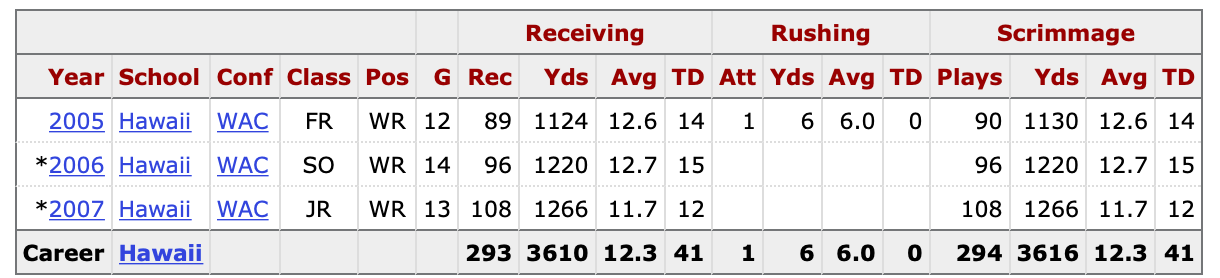
There are more notable seasons but I think the point has been made. Clearly this system has been a good one as far as WR production is concerned.
I wish I could tell you which of those early/mid 2000s WRs played where in the offence, but this was before my time as a fan. Bess is a smaller player (5’10”), so I assume he operated from the slot. So is Chad Owens—who is listed at 5’8”; he more so than Bess most likely operated from the slot.
So it would appear, at least from a cursory look back, that the slot position in this offence has been the primary read in years past.
I think that pretty much summarizes what you need to know about the historical production within this system. Chang’s first season continued the trend at WR with both Pofele Ashlock and Steven McBride fielding productive campaigns. The 2024 season wasn’t quite as fruitful. In fact, even Ashlock himself (UH’s WR1 on the year), did not really stand out as a CFF asset.
And now I can add some commentary on top of the previous commentary and include what happened in 2025. This is fun… I suppose in 2027 we’ll do this all over again…
Obviously, by now you probably know that Jackson Harris had a good year with Hawaii. He finished as the WR1 in fact, averaging over 20 PPR PPG, while appearing in 10 games.
That season in conjunction with the previous two produces a WR1 PPG average of 17.7 for Timmy Chang since joining as Hawaii’s head coach. Pretty good stuff. This is definitely a system worth prioritizing if you’re a prospecting CFF manager.
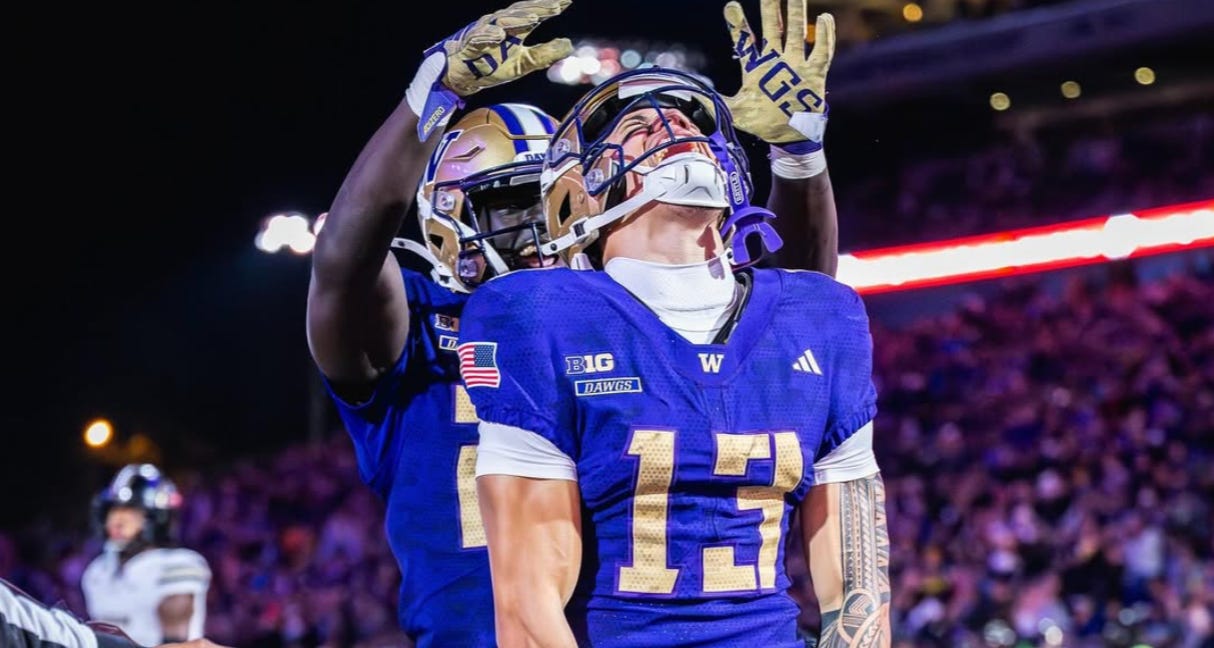
AUDRIC HARRIS (6’1, 200)
2025 RECEIVING STATS: 5-99-1 (3.5 PPG)
There is not much to say about Harris at this point. As mentioned in the linked article in the intro he played high school football in Nevada with current Hawaii QB Micah Alejado at powerhouse program Bishop Gorman.
I’ve linked Harris’ only TD of his career thus far here for those interested:

This will actually be Harris’ third team in as many seasons, first beginning his career at Arizona as a former three star recruit from Bishop Gorman high school where he played with QB Micah Alejado.
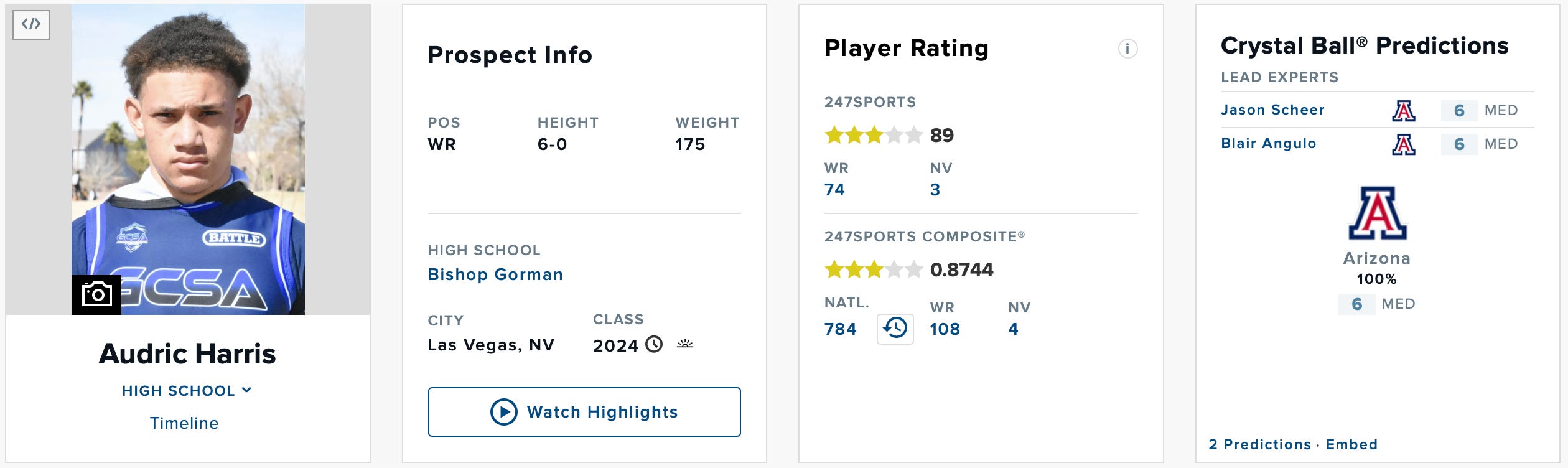
It will also interest the reader to know that Harris scored 13 TDs as a senior in high school off of the arm of Alejado, so there’s already some chemistry here.
Here is a snippet from an interview done on the G5Hive where the writer speaks about Audric Harris and how he’s looked thus far on the big island:

Overall, there’s a lot to like here and the fit feels pretty snug with Jackson Harris moving on.
We should be cautious not to expect another Jackson Harris season from Audric, however, but it seems reasonable that he’ll win one of the starting jobs and therefore will at least be a viable CFF asset in 2026. On the off chance that he can replicate something resembling Jackson Harris’ 2025 season, or Steven McBride’s 2023, Audric is a great player to target late in drafts right now. He currently has an ADP of 201 according to Campus2Canton. ◾
If you enjoyed this content and would like to read more, I recommend joining the Pigpen, a community of thousands of degenerate college football fans: