
CSU's Mel Brown Looks Like Mora's Next Cam Edwards
There may be some Volume Piggery a foot up in the mountains.

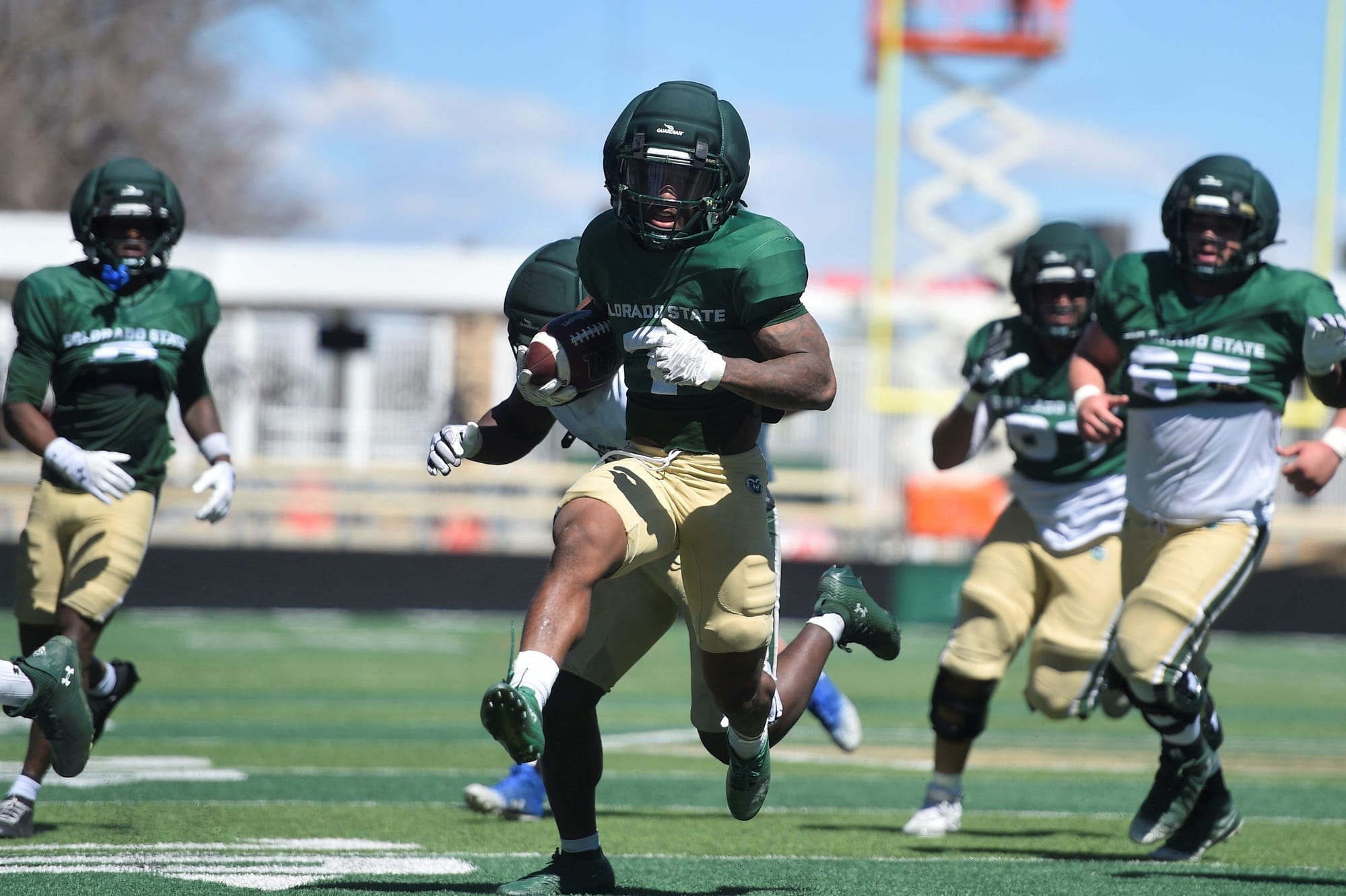
The mountains are calling and I must go.
- John Muir, naturalist
One of my favourite articles ever written when I started this publication was a write-up on Colorado State Ram Tight End Dallin Holker. That was in the Jay Norvel-era of the CSU Rams program. TEs were a focus area in his system given what he had done at his previous stop, Nevada, namely with Cole Turner.
Well, that era is over and in comes Jim L. Mora from UConn, previously of UCLA and the NFL. Mora doesn’t have the same track record at TE, or really any position for that matter that Norvell had at WR/TE when he joined CSU.
However, Mora’s RB1 last year, Cam Edwards, had a phenomenal year in CFF and with that comes a renewed focus on who Mora’s RB1 might be this upcoming season.
Thankfully for us as CFF managers, some early clarity was provided on the matter. Those of you who were following along with the spring game updates will recall this snippet:
Mel Brown, running back
Brown may be the front-runner from spring to be CSU’s No. 1 back. He’s not a big back (listed at 5-foot-9 at UConn) but quick, strong and versatile.
He looks like a quick and powerful runner but also an able kick returner. Brown should be a fun player for CSU.
Brown had a couple big plays in the spring game that showed his potential.
“That’s who Mel is and that’s why I’m happy he’s here with us,” Mora said.
That snippet isn’t a massive endorsement, but it is something at least, especially when many were expecting former UConn/Auburn player Durrell Robinson to be the de facto RB1 coming into 2026.
In addition to the question of who will actually win RB1 status, the more salient question in my mind is: how much does this even matter? To answer that we should look to the historical track record of the system, rather than concentrating on one year (2025).
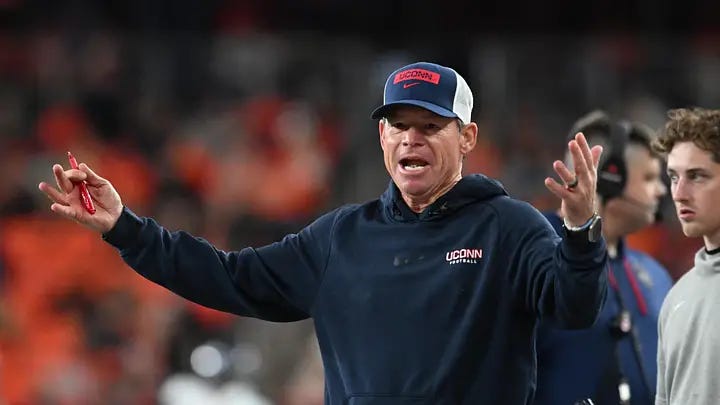
COACHING & SYSTEM
RB1 PPG AVERAGE (excluding 2025) — HC: 12.6 — OC: NA
To say Mora’s RB1 system at UConn was nothing special is not an understatement. Outside of last season, his runners never saw 15 or more carries per game, and never averaged more than 15 PPG.
Overall carry share tells most of the story as to why that was, only one runner in the three seasons leading up to 2025 saw more than 30% of the team carry share. To put it another way: committees were the vibe this staff was on at UConn prior to last season with Edwards.

A deeper dive tells a bit of a different story, however. When Mora was last a head coach in college (UCLA, 2012-2017), there are two notable names. The first is Jonathan Franklin, who saw 282 carries in 2012, rushing for 1734 yards and 13 scores, with an additional 300+ receiving yards on 33 receptions and two more scores.
That was just one season though. The next name, Paul Perkins, was a repeat offender within the context of volume piggery. Perk handled the rock 251 times in 2014, rushing for over 1500 yards. He then handled 237 carries the following season, accumulating over 1300 rushing yards. He added 200 yards in receiving in both of those seasons as well.
So, I would not classify Mora as a committee coach; rather he seems pretty flexible and is agnostic about individual carry share. What’s more important is whether there is a player who is head and shoulders above the rest in his backfield. If the answer is yes, that player will receive a lot of work.
Other characteristics of Mora’s system include: a 57% historical skew towards the run, a slow pace of play calling at around 28 seconds per play, and an outside zone run scheme that is typically deployed.
I won’t go into involved detail about what an outside zone run scheme means, but the relevance of it in trying to assess which RBs might be effective here under Mora is that the system requires a player who can make a quick upfield cut when the defence over pursues on the outside. The idea is to try to lull them to sleep with repeated outside runs to eventually set up a big cut back upfield for (hopefully) a long TD.
In fact, the mantra of the scheme is defined by this quote: “The more you run it, the more effective it becomes!”
This requires a lot of patience, good vision, and a runner who can turn upfield quickly and preferably with some considerable speed.
So, in saying that, a player like Mel Brown who is a bit smaller, but very quick and decisive can absolutely run this system effectively. Whether the others behind him can also do so effectively will probably be what determines whether Brown (or someone else), can be a #VolumePig in 2026.
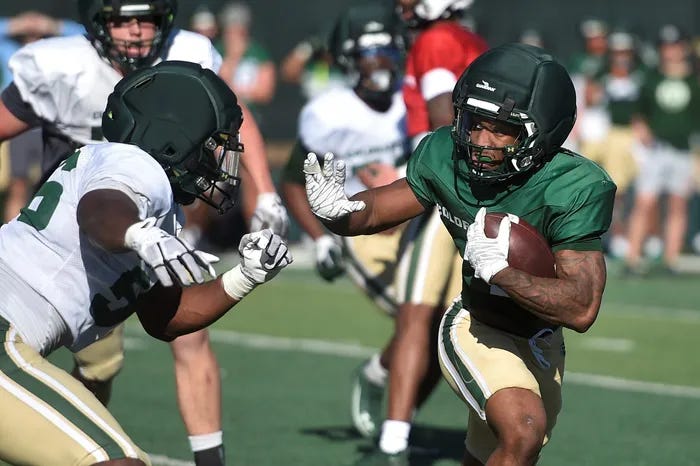
Mel Brown (5’9, 180)
2025 RUSHING STATS (five games): 32-262-2 (8.7 PPG)
Brown is definitely on the smaller side weight-wise but he doesn’t have an alarming profile for a G5 RB in my opinion. We’ve seen players like this perform exceptionally well at that level before.
He started his career at the FCS level—Gardner Webb—in 2022. During his freshman season, he took 76 carries for 459 yards and six TDs, which is a pretty successful frosh campaign in my view.
In his second year he carried the ball 113 times for 629 yards and five scores, before transferring up to the FBS in 2024 to play with Mora at UConn. Statistically, his first season with the Huskies was very similar to his last in the FCS—he rushed 118 times for 673 yards and two scores.
In 2025, due to injury he only appeared in five games and his stats were fairly forgettable behind RB1 Cam Edwards.
In terms of what he can do as a receiver, his best season on this front was in 2023 with Gardner Webb. He caught 18 passes for 253 yards and five(!) scores. If you’re keeping track at home, that means in 2023 our man scored 10 TDs on essentially 130 touches. That is a very efficient season. Clearly this guy has a nose for the end zone. Or at least he did at the FCS level.
This will be Brown’s final year of eligibility and by all accounts from spring coverage, he is putting his best foot forward to have a good year. Here is what one writer who saw the spring game said:
The longest rush of the game belonged to UConn transfer running back Mel Brown, who showed the breakaway ability he looks to add to the position. Brown was limited to only four games in 2025 with the Huskies but averaged 8.2 yards per carry before getting injured. This will be his final year of college eligibility after starting his college career with two seasons at Gardner-Webb.
Though, the running back room goes deeper than just Brown.
“I like the depth of that room,” Mora said. “They’re all a little bit different kinds of runners; they give us a little different flavor.”
Here is what another article included after the spring game:
Brown, who came with Mora from UConn, leads the group, but the depth should be an advantage in the fall. Every member of the room possesses different skills and qualities.
“I like the depth of that room,” Mora said. “As I said, we have several guys that were out, but I love the depth in that room. I think they’re all a little bit different types of runners. They give us a little bit of a different flavor.
“I think they’re very smart. I think they’re very well coached. They can pass protect and they’re tough kids. And they know how to find the end zone.”
On the face of it, I’m not getting the vibe that this is going to be a 250+ carry year for Mora’s RB1, no matter who that ends up being.
It’s good that Brown seems to be viewed as the frontrunner at this stage, though, and if we look at Cam Edwards’ 2024 season—a year in which he averaged around 13 PPG—we see that, despite filling in more as a RB1A, he had individual highs of 19, 20, 16, 14, 19, 13, and 27 points in the 13 games he played. That’s not bad at all, especially in deeper leagues. And even more so in deeper, bestball leagues where you didn’t have to anticipate when those performances would come.
With that in mind, I think something resembling Cam Edwards’ 2024 campaign is the goal here for Mr. Mel Brown. If he can achieve that, it would be a success from a CFF standpoint and I do think it’s a realistic outcome.
A few concerns would be that it seems like either QB who is competing to start will be a runner too, and the repeated mentions of “depth” from head coach Jim Mora probably foretells a healthier rotation of backs over one runner who gets leaned on. An RB1A role seems like the best outcome to hope for with regards to Brown’s CFF stock. ◾
If you enjoyed this content and would like to read more, I recommend joining the Pigpen, a community of thousands of degenerate college football fans: