The harder the conflict, the more glorious the triumph.
- Thomas Paine, Revolutionary
Pictured as the backdrop in the video above is a fictional strike squad from the US Navy’s carrier air wing. The components of the strike force include four F-14s, four F/A-18s, two S3-As, two A-6s, and the ever-essential E-2 Hawkeye in the back.
In a hypothetical scenario where the photo isn’t fictional, the F-14s and F/A-18s would be serving as the bodyguards in the sky for this strike package—they are the only two models pictured capable of fighting other jets, while the S3-As would handle submarines in the water, the A-6s would be carrying the load to be dropped on the unfortunate targets, and the E-2 would be the eyes and brains of the carrier group. Each one serves a specific purpose in the ecosystem of the strike unit.
While each of these models really were non-fictional pillars of the US Navy air wing at one point or another (A-6 was actually retired in 1997), it is unlikely that there would have ever been a strike force postured in the way that is shown in the video.
For one, it would be atypical for S-3As to be embedded in the group as pictured above. These models rarely penetrated contested air space as they would not be able to defend themselves without escort, and presumably to provide their function properly they would need to be flying near the accompanying carriers they are defending.
The other observation is that a formation containing four F-14s and four F/A-18s would also be an extremely rare sight. Not only is this a large strike force, conventional fighter-to-bomber ratios are 2:1 or 3:1. This particular strike force is postured in a 4:1 ratio. That is a lot of firepower to escort the A-6s. In this hypothetical universe, this group must have been expecting some extremely heavy resistance on the way to their destination.
Fire is the test of gold; adversity, of strong men.
- Seneca
In the ideal scenario, I imagine college football coordinators would like to have a perfectly balanced offence, where they can trust the passing and running assets of the system in equal measure.
However, sometimes shit just happens, and one finds themselves in something of a dire position. There are four teams I’m covering today that, for one reason or another, are going to need to effectively run the ball against heavy resistance to be successful in 2026.
The good news is sometimes the most productive RBs in college football are a result of not just their own talent, but the lack thereof around them, particularly in the passing game (see chart in Appendix).
The prerequisite carry concentration is unwavering in this context, but assuming a player is getting most of the team’s carries behind an effective offensive line, mixed with a passing attack that is distrusted by the coaching staff, then there is a potential recipe for high level production (e.g., SDSU’s Lucky Sutton, PSU’s Kaytron Allen and Nebraska’s Emmett Johnson immediately come to mind).
When the passing game fails to threaten the defence, typically the defensive scheme shifts to provide additional resources against the running attack. This is potentially the fates of the four programs I’ll be discussing today.
However, working in their favours is the fact that each may have enough resources on their side in the run games to overcome their (potentially) lagging passing attacks. Indeed, when one enters enemy territory without the element of surprise, it’s generally wise to gear up for a brawl ahead of time.
It starts with the offensive line. Effective blocking is a prerequisite to an effective run game. These guys are like the F-14s and F/A-18s. Without effective execution from them, the mission is hopeless. All four programs covered today are top 21 in returning offensive line snaps from a year ago according to Dawgstats.
The next unifying feature of all four teams is a major question mark/concern regarding their passing attacks for 2026. I will cover this in detail in each individual section. Finally, the triangulating piece of the puzzle here is the presence of a name that stands out, either as a returning starter, or a proven transfer, at RB.
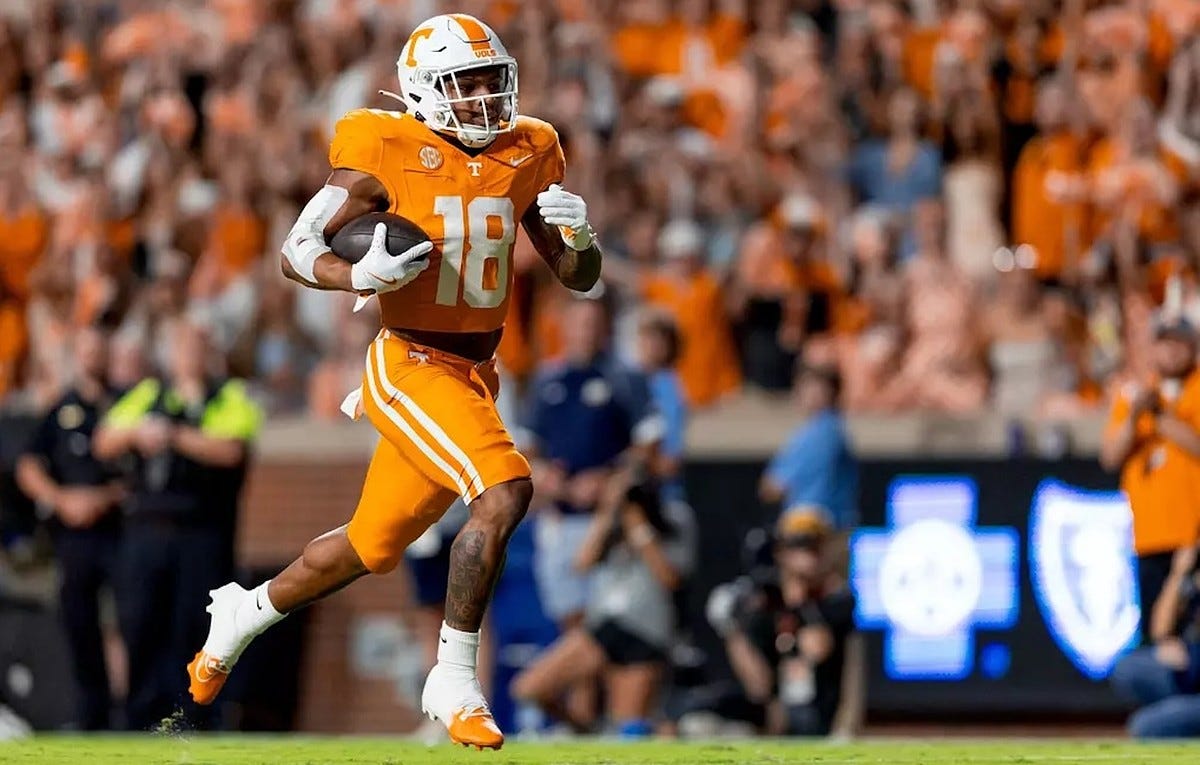
TENNESSEE VOLUNTEERS
feat. DeSean Bishop
One of the higher profile litigation cases of eligibility being challenged this offseason features former Tennessee QB Joey Aguilar, who is requesting an eighth season of college football.
Never say never in this world, but it feels unlikely that he will be granted an octonary campaign. In which case, Tennessee will be left with CU transfer Ryan Staub, former four star George MacIntyre from C/O 2025, and incoming five star freshman Brandon Faizon.
Not great, Bob, or should I say Josh. Even if they end up rolling with the freshman wunderkind, as we’ve seen with various other programs who did the same, there is usually a steep learning curve involved and the offensive coordinator typically does lean on the run-game to provide relief to their often-overwhelmed QB.
That’s where the offensive line and RB come in. F/A-18s on the outside include C/O 2025’s potential second highest paid prospect LT David Sanders, who returns after starting as a freshman and Jesse Perry, who started at RG last year but will likely move out to tackle to replace Lance Heard this season.
F-14s on the inside include Sam Pendleton and big Wendell Moe, who were both starters for the 2025 team at centre and guard, respectively.
If you’re keeping score at home, that is four of the five starters from last year’s line that blocked for 1000-yard rusher DeSean Bishop (averaged 17 PPG), who by the way is also returning.
A native of Knoxville, TN, Bishop is a real life hometown hero. As a true sophomore, he ascended as the 2025 season unfolded and finished with a neat 1200 yards total and 16 rushing scores.
On one hand, that is a lot of rushing TDs for someone who only handled the rock 182 times. On the other, his carry volume didn’t really stabilize until October. From that point onward he was seeing 14+ touches every game.
With fellow RB Star Thomas now out of the fold (headed to NFL), there is little resistance to challenge Bishop’s reign at the top. Tennessee did make a very underrated move (imo) with bringing in former Tulane freshmen standout Javin Gordon. I liked what I saw from Gordon last year but it is telling that his former coach, Jon Sumrall, did not feel the need to bring him with at Florida.
Tennessee’s September next season includes FCS program Furman, ACC program Georgia Tech, the SBC’s Kennesaw State, and Texas in-conference (remember the SEC went to nine conference games effective immediately). Other conference opponents include Auburn, Arkansas, Alabama, South Carolina, Kentucky, Texas A&M, LSU, and Vandy. Even with avoiding UGA, I think that schedule is harder than last year’s.
But in saying that, Bishop and Tennessee’s run game held up pretty well last year in conference (only dud was vs. UGA). The only inter-SEC games where he failed to score 20+ PPR points was vs. Mississippi State (14.2), Kentucky (16.8) and OU (12.9). He actually had one of his best games vs. Alabama (24). And even in a 24-45 loss to Vandy, Bishop salvaged 23 points.