

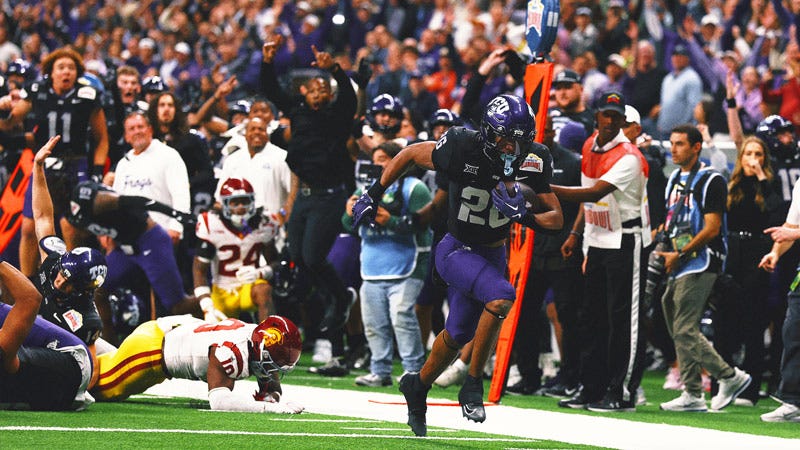
Intuition is a very powerful thing. More powerful than intellect.
- Steve Jobs, entrepreneur
As per annual tradition, last offseason I competed in the Golden Pig Invitational draft over the summer. The league was in its third iteration at that point and the competition pool had only continued to strengthen.
I had the second overall pick, and decided early on (as usual) that I would remain committed to investing in the RB position early. A triple-tap in rounds one through three kicked things off for my roster, before a brief departure with two WRs selected: UW’s Denzel Boston, and UH’s Pofele Ashlock.
In the sixth round, a decision had to be made: return to RB as planned, where there were few, if any, names that were particularly appealing to me, or look elsewhere at QB/WR.
Earlier in the offseason I had not been a big believer in returning Nebraska RB Emmett Johnson. Sure, he finished the season on a tear under newly promoted OC Dana Holgerson, but neither the OC nor the head coach, Matt Rhule, had a favourable history at RB within the context of CFF.
Put bluntly, these guys were committee men. However, the usage in Johnson’s final five or so games in 2024 was alarming enough to warrant his consideration. Especially considering it coincided with a structural change around him (Holgerson taking over OC duties mid-season), the narrative I could tell myself was easy to construct.
I knew CFF Jared was high on Johnson and professed as much at every opportunity during the offseason. Coming off a disappointing 2024 campaign, I decided I would make an allowance and trust someone else—that although I wasn’t fully convinced, perhaps taking a leap of faith would pay off.
In the end, while I would like to take credit for drafting Emmett Johnson—who had a ridiculous 2025 season and helped carry my squad to several victories—I have to admit that when I selected him, I was not too chuffed about it. Of course, that sentiment changed very quickly after week one.
As always in CFF, we are, as managers, typically seeking to recreate our successes. Whether it was drafting the next Boise RB after Ashton Jeanty left, or spending years wasting draft picks on WKU’s starting QBs after the success they had in the early 2020s, the age old going back to the well is a common thought process utilized in this space.
However, I would implore the prospecting manager to utilize this thought process more abstractly and think more in terms of profiles rather than simply budgeting for a reinvestment into the same systems.
In this case, if we think about Emmett Johnson for a moment, part of what made his profile what it was, was the receiving utilization. He was great at it, and Nebraska’s QB needed the safety blanket because he just wasn’t very good at other stuff. Dylan Raiola was not a mobile QB either, so he wasn’t eating up yards on the ground, nor stealing red-zone scores.
Holgerson, the OC, likely trusted EJ a lot more than Raiola, hence the absurd usage that the 5’11, 200-pound playmaker out of Minnesota received on frequent occasions.
And by the way, this is probably a good place to mention this: it is sort of a miracle that EJ held up with his slighter frame all season. He was both incredibly effective AND incredibly durable in 2025. That is a rare combination. Indeed, I’d argue that finishing as a top three/five CFF RB comes down to durability as much as anything.
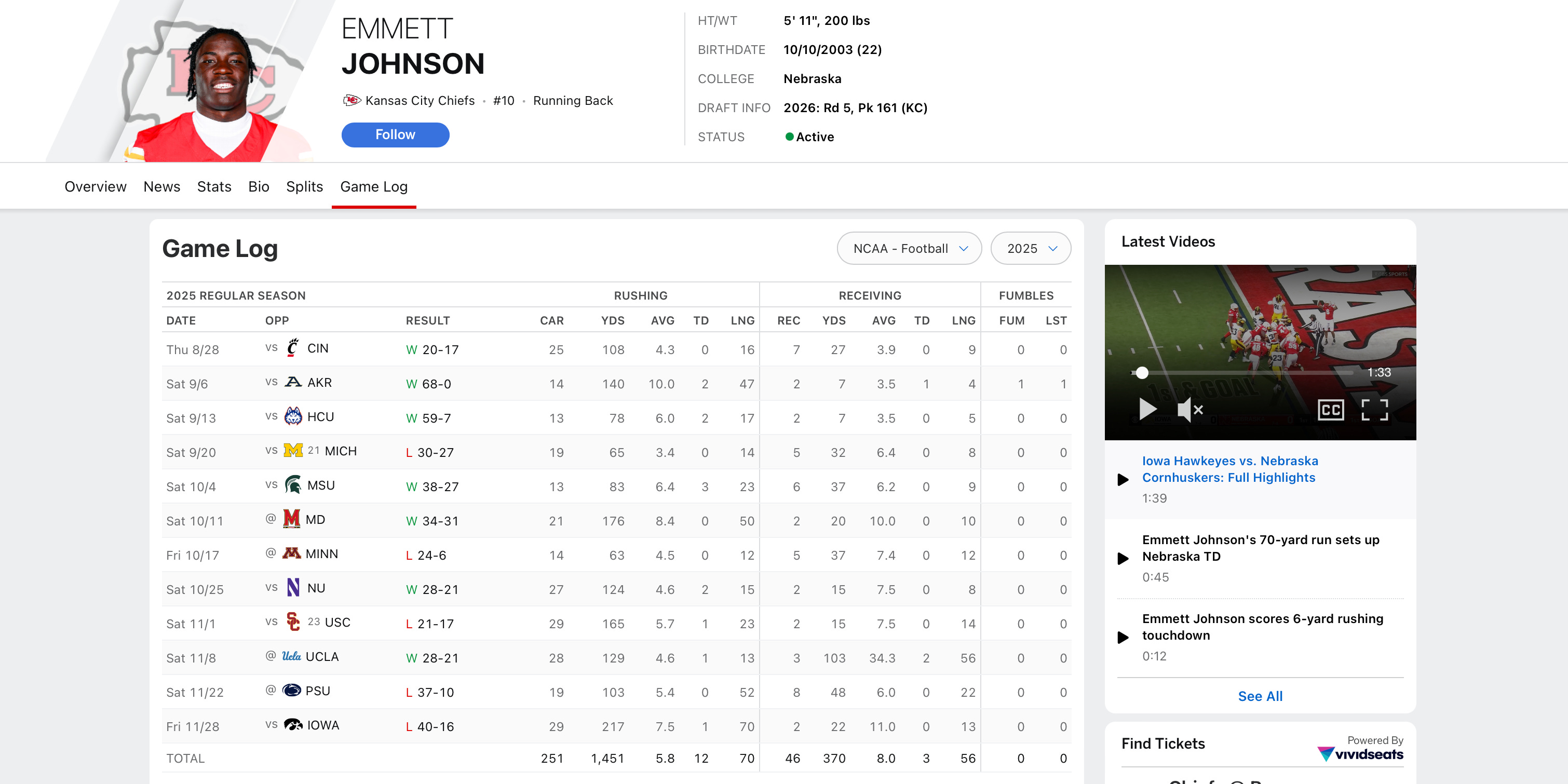
When considering his targets, EJ saw 311 opportunities (251 carries + 60 targets) in 2025 over the course of 12 games. That is 25.9 opportunities per game, or 24.75 touches per game if we only consider his receptions. Pretty good stuff.
TCU RB Jeremy Payne: The Case to be This Year’s EJ
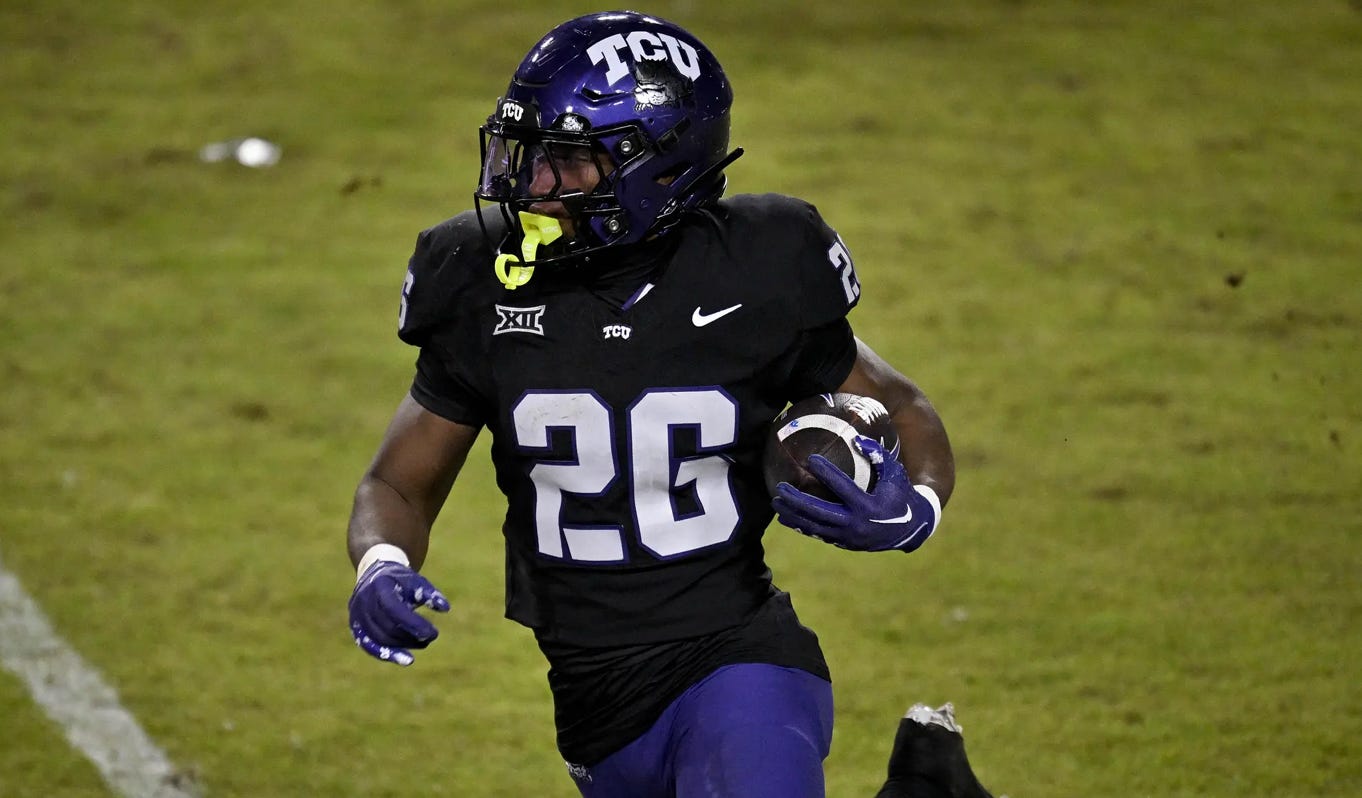
Perhaps TCU RB Jeremy Payne’s biggest knock is his size. He is listed with a slight build at 5’10, 180 pounds per Fantrax. Though, per reports, he does not run like a small RB on the field (and I’d agree with this based on his performance last year when he became the bellcow). Here is an article published on 247 Sports:
It might come as a slight surprise to have TCU’s RB1 this high on the list, but that’s simply a testament to the type of fall camp Payne has had. He’s running much bigger than his 5-foot-10, 180-pound frame would suggest, while consistently making defenders miss in the open field.
Beyond his pure rushing ability, it’s clear Payne has taken a step forward as a receiver out of the backfield, too, which will be a significant part of the offense this season under Gordon Sammis. He’s in line to be the next on a long list of memorable TCU backs who have dazzled fans throughout the years.
A few more notes to consider: Yes, there is a new OC in town for the TCU Horned Frogs, and his name is Gordon Sammis.
Sammis joins after a stint with UConn, where Cam Edwards averaged nearly 20 PPG in PPR formats, with a total of 1400+ yards and 16 scores in 2025. Edwards received 230 touches in 13 games, which is approximately 18 touches per game.
TCU’s new OC was with UConn from 2022 to 2025, first joining as the OL coach (2022-23), then handling OC duties (2024-2025), as well as interim HC duties when Jim Mora left late in 2025.
So how are things going so far with Sammis at TCU? Here is an update from a monthly roundup article I did covering Mid-July:
“He’s an offensive line coach that’s a play caller,” Sonny Dykes said. “There are not too many of those in college football.”
As a result, TCU is trading a perimeter-oriented passing game for a run-first system designed by a coach who lives in the trenches, and Dykes came away from spring convinced it was the right call.
“We have to have a great fall camp, but coming out of spring football, I was really comfortable with where we were, again, most importantly, with him,” Dykes said.
CFF Wisemen will tell you that an OL coach calling plays has long been considered a harbinger of good things for the RB position.
A scheme change towards a more run-first oriented approach is an important note CFF managers should consider. Given Sammis’ work last season with Edwards, I have no reason to doubt him in this regard.
The question will then be: how will the workload be divided among the RBs? More like UConn 2024? Or UConn 2025?
I’m going to go out on a limb and suggest it will probably be more like UConn 2025 with Edwards, especially given the prior note from the 247 Sports article. From updates I have seen out of TCU, there appears to be little confusion over who the starter will be or who the best RB they have is.
Mentioned above was that an important part of EJ’s profile was his receiving usage as a safety valve for a QB who—despite being a returning starter—was still inexperienced and probably a bit over his head.
Payne has the opportunity to be something similar for Sammis and this TCU offence in 2026. Harvard transfer Jaden Craig will be playing in his first season of FBS ball this upcoming fall, and we really don’t know how he will transition up to this level.
In any event, even if the transition is smooth, he is not a mobile QB (at least, he wasn’t in the FCS and I’m not expecting that to change in the FBS). That’s good news for the RBs in general. In particular, given the note that Payne has “taken a step forward” as a receiver, and that this is expected to be a “significant” part of the offence this season.
So there are a lot of similarities between the two profiles—2026 Payne and 2025 EJ. One difference, however, are the respective head coach’s track records at RB in a CFF context.
The Sonny Dykes RB1 has long been a coveted asset in CFF circles. In contrast, seldom have Matt Rhule RB1s been effective in CFF leagues. I asked Claude AI to fetch me Dykes’ RB1 stat lines from each HC/OC stop during his career.1
It flagged the seasons it wasn’t sure about. Though those of us who’ve been playing this game for a little while can personally verify the 2019, 2022, and 2023 stud seasons.
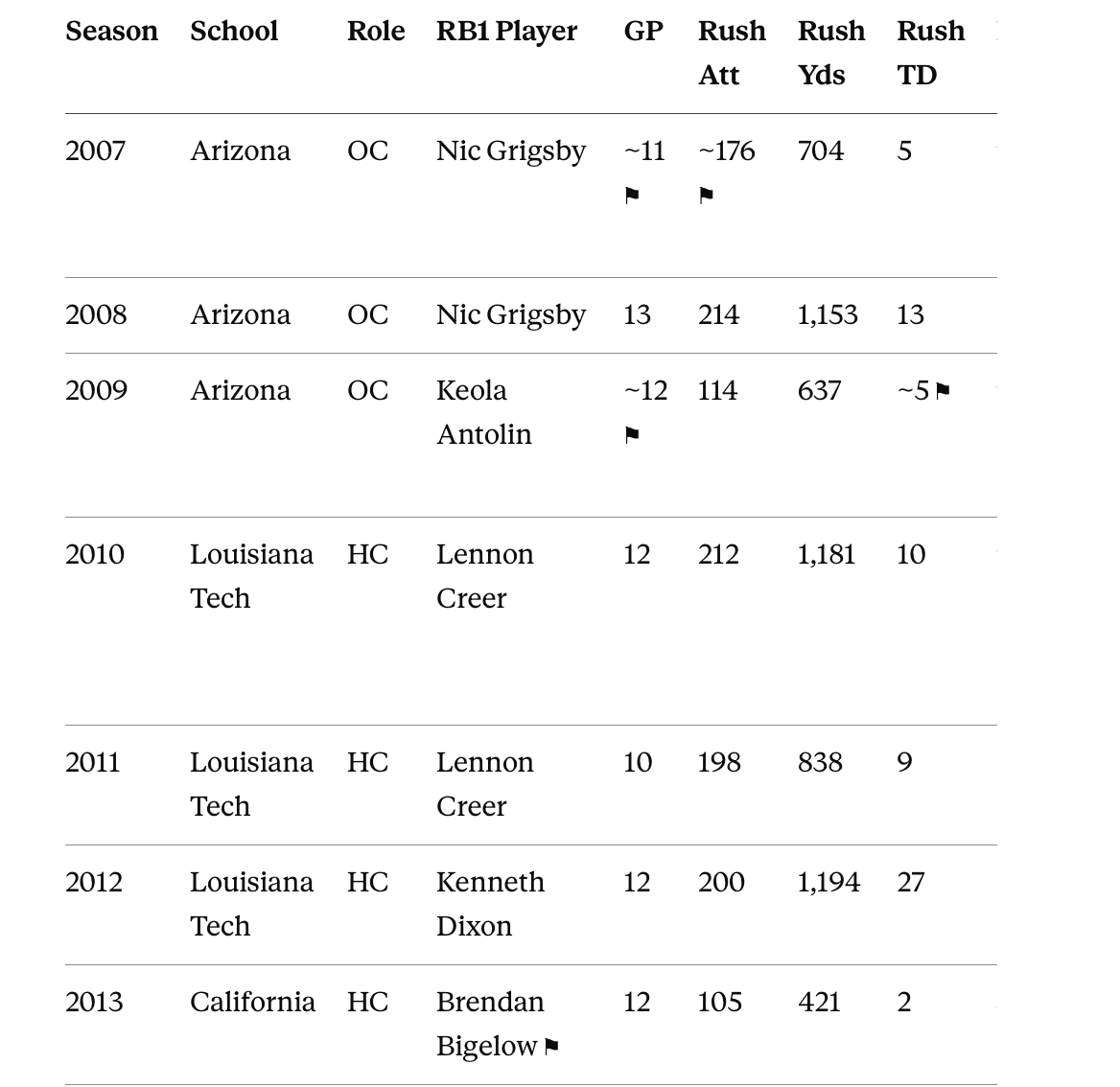
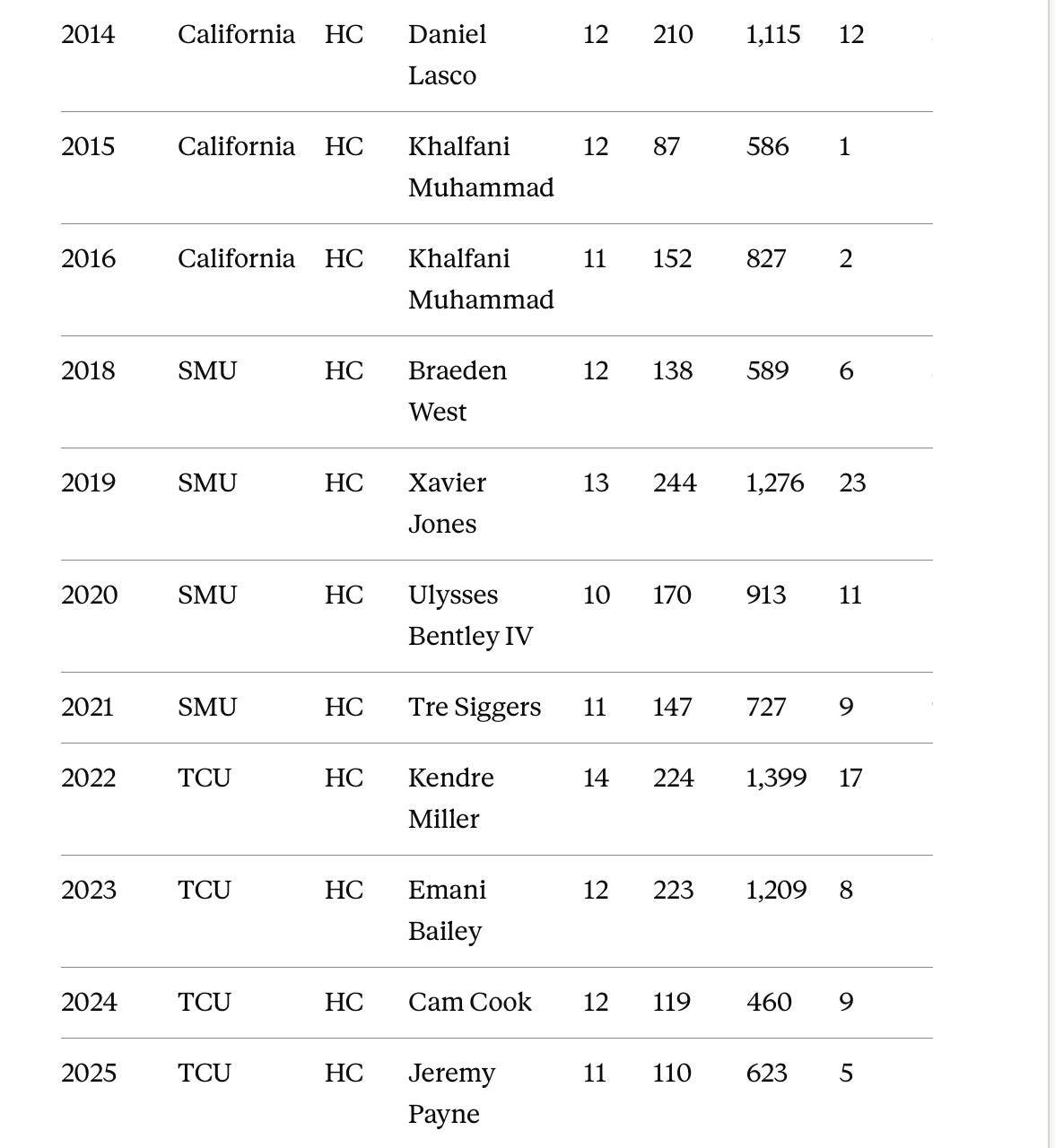
Three seasons is the longest stretch Dykes has gone as a HC or OC without a 1000-yard RB. His streak is currently at two seasons. But context is important: Kevorian Barnes was the bellcow earlier in 2025 and was a suitable asset to roster in many CFF leagues. Then Payne took over and he was a highly coveted asset for the final week of the regular season.
When Payne took over late last year as a true sophomore, he saw 19 touches vs. Houston in a game that saw him run for over 100 yards, though he failed to score a TD. He made up for the lack of TD production over his next two starts, however, closing out TCU’s season with two and three TDs vs. Cincinnati and USC.
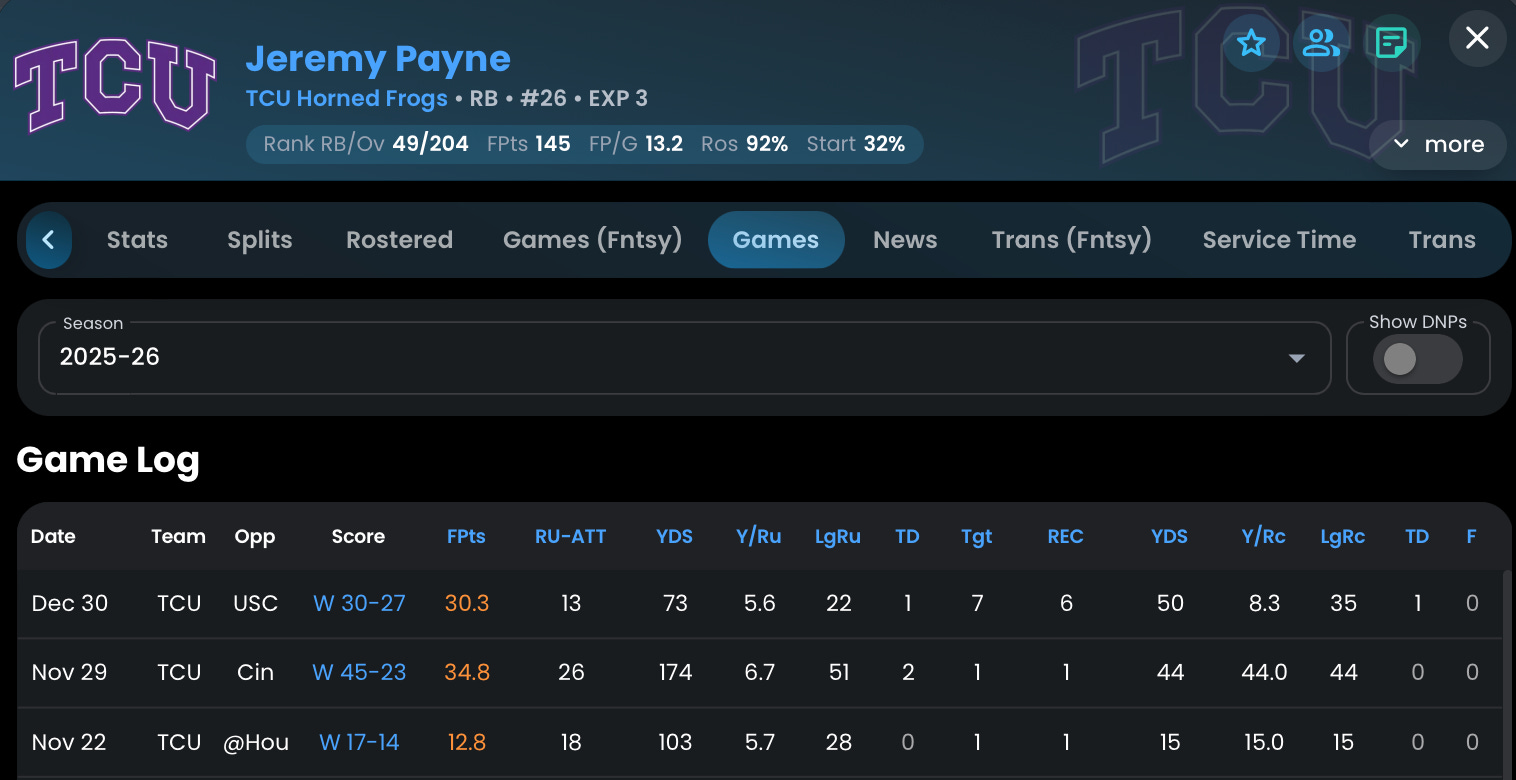
It’s not often that you see a RB with long receptions including 44 and 35 yards. Even 15 is a large receiving yardage marker for a tailback to achieve. I find these data points to be encouraging in the context of some of the things we discussed earlier in this article.
I would hope that a suitable combination of carries and receptions is administered for the under-sized Payne, and through that combination of touches yields a 15-20 touch per game asset within TCU’s offence. 20-25 is where EJ lived, so for this comparison to truly live up to the billing, that’s where Payne will have to be too, but there is a caveat in that BIG12 defences are not typically as stingy as B1G defences.
Nebraska didn’t have a gauntlet in-conference last season, avoiding Oregon and Ohio State, but they did play Michigan, Iowa, and Minnesota (who are usually stingy on D).
Those games comprised three of Nebraska’s five losses (the others were to USC and PSU).
TCU plays Utah and Texas Tech to close out the season. Tech will be the most talented front seven they see all season. I’m not so sure what Utah will look like in the post-Whittingham era, but they’ll probably be solid against the run too. Outside of that, they have a very smooth schedule with the only other hiccup being a BYE in week one (they play UNC week zero in Ireland).
The two BYE weeks will make it more challenging for Payne to finish as a top five RB from an aggregate points measurement, but it seems likely he will have a good shot at being a top five RB from a PPG perspective, which, over the course of 11 games will do some sizeable damage to your opponents in CFF leagues. ◾
If you enjoyed this content and would like to read more, I recommend joining the Pigpen, a community of thousands of degenerate college football fans:
Season-by-season notes on the highest earners
Xavier Jones, 2019 SMU (306.6 FP): Per SMU Athletics, Jones “started all 13 games… led the nation in scoring (11.5) and rushing touchdowns (23)… registered a team-leading 244 carries for 1,276 yards… added 20 receptions for 90 yards and two TDs,” setting SMU records for season TDs (25), rushing TDs (23) and points (150). His 23 rushing scores are the single biggest reason he tops the list. SMU Athletics
Kenneth Dixon, 2012 Louisiana Tech (300.9 FP, best FP/G at 25.08): Per LA Tech Athletics, Dixon “ran for 1,194 yards and an NCAA record for a freshman 27 touchdowns on 200 attempts,” breaking Marshall Faulk’s mark; he added 10 catches for 35 yards and a receiving TD, and was the 2012 WAC Freshman of the Year and a Freshman All-American. Wikipedia + 2
Kendre Miller, 2022 TCU (269.5 FP): Per his New Orleans Saints bio, Miller “started all 14 games he played in and led [the] Horned Frogs with 242 carries for 1,399 yards (6.2 avg.) and 17 TDs [and] hauled in 16 passes for 116 yards” — the most rushing yards by a Horned Frog since LaDainian Tomlinson in 2000. (Sports-Reference counts 224 rushing attempts once bowl accounting is applied; the Saints bio’s 242 reflects all carries — the yardage/TD figures used here are consistent across sources.) NFL Draft Buzz
Daniel Lasco, 2014 California (264.1 FP): Per Cal Athletics, Lasco was “the first Cal player to rush for 1,000 yards or more since Isi Sofele in 2011,” totaling 1,115 rushing yards on 210 carries with 12 rushing TDs (14 total), plus 33 catches for 356 yards and two scores across 12 games — Cal’s 2014 team MVP. California Golden Bears + 2
Emani Bailey, 2023 TCU (218.3 FP): Per TCU Athletics, Bailey “rushed for a team-best 1,209 yards and eight touchdowns while adding 25 receptions and a receiving score,” ranking 14th nationally at 100.8 rushing yards per game over 12 games (223 carries). The Dallas Morning News