
Let's Try This Again: This Houston Cougar Could Finish as WR1 in 2026... Wait, Really??

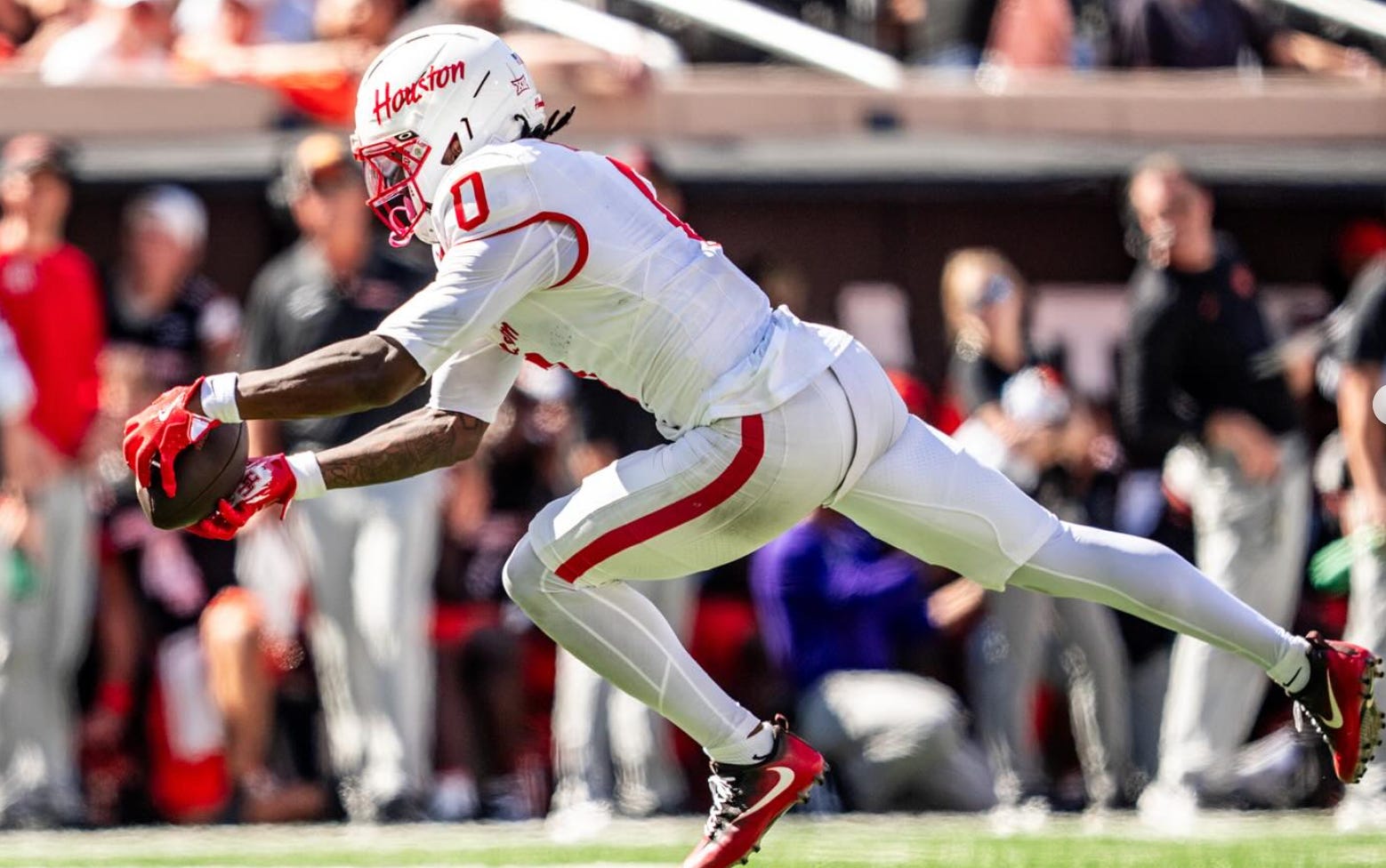
On the midnight plane to Houston. Goin' back to a simpler place and time.
- Jim Weatherly, musician
I have to go give a quick shoutout to the esteemed CFF analyst, Eric Froton, who pulled the trigger and selected Houston’s Amare Thomas in the first round of CFFJared’s Way Too Early Mock back in January.
I was already going to write about Thomas (for like, the third year in a row), and already kind of have here, but that selection just cemented the need to do so. Back in Thomas’ UAB days, I was optimistic about his CFF outlook and wrote about it here:

It was, in some sense, a sequel to an article I did in 2023 about UNLV’s WR Ricky White.

The general idea was to pick out a WR who hadn’t done much yet, and make the case for why they could end up dominating the stat sheet the upcoming year (and perhaps even finish as WR1 in CFF).
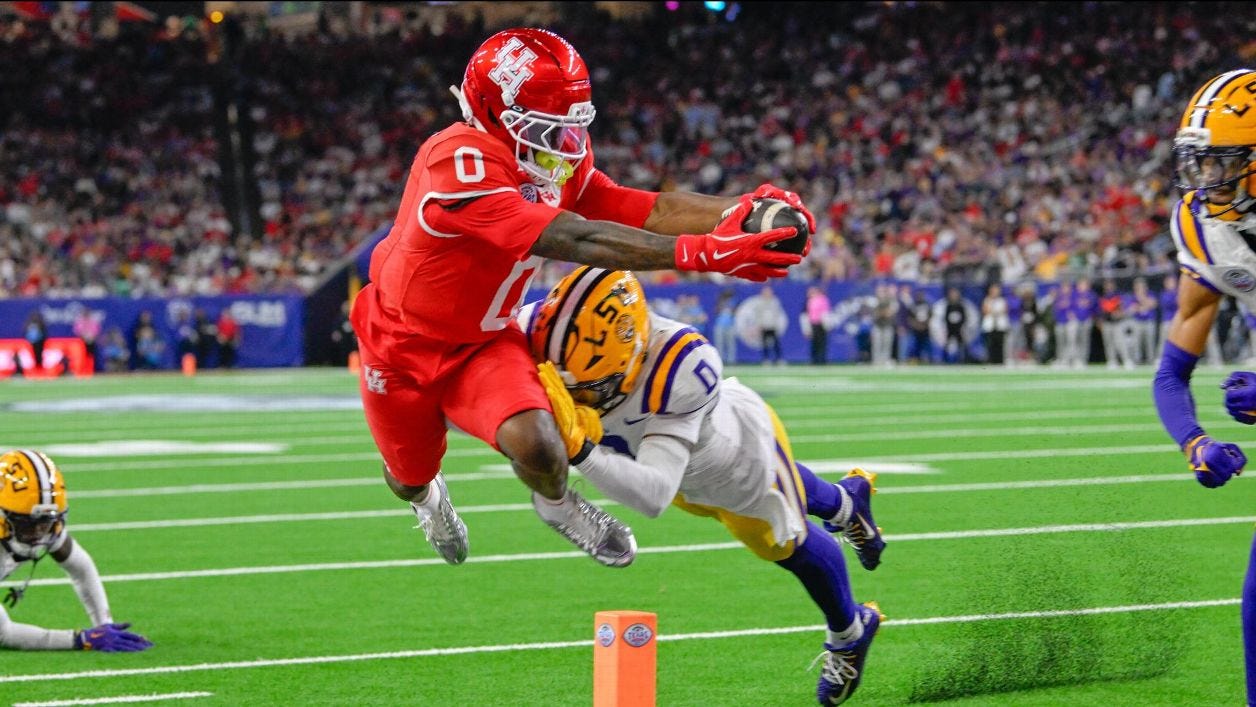
Amare Thomas, I must admit, was a pleasant surprise to me this past season. I didn’t really have a lot of expectations around what this Houston passing attack would do, and I definitely wasn’t expecting them to support a really productive WR. Thomas actually finished as a top 20 PPR WR in PPG, and he scored a lot of TDs (12 in 13 games in 2025), so that’s always good too. He’s actually scored 20 in his past 25 games going back to UAB. This is a TD merchant if I’ve ever seen one.
But 2026 is a new year, and with that means the addition of new variables to the equation. So who did Houston bring in this offseason? Well, the big name at WR is former Oregon State target sponge, Trent Walker. There is also someone called Muizz Tounkara, who is a freshman coming over from the Florida Gators.
And of course, at RB there is a reunion of coach and player via former Tulane/Oregon runner Makhi Hughes.
Hughes’ inclusion may end up being trouble for QB Connor Wiegmann, who made a living off of rushing TDs in 2025, or it’ll be vice versa, I’m not sure yet, but it shouldn’t in theory negatively impact Amare Thomas.
Walker’s inclusion is potentially problematic. Ironically, his profile is sort of the opposite to Thomas’, where the Houston receiver scored a lot of TDs the last two seasons, Walker’s been unable to find the end zone with regularity (four TDs in 24 games) despite a lot more targets (222 vs. 193).
Something’s got to give on Trent Walker, man. 200+ targets for a player and only scoring four times is bizarre.
At the very least, Walker is taking some targets away from Thomas, but it doesn’t necessarily have to mean that Thomas’ overall target numbers will go down. This wasn’t a team that threw the ball a ton last year, so maybe they simply increase the pass attempts.
While Weigmann finished 13th overall, and ninth in PPG for QBs, it wasn’t necessarily due to a volume of passing opportunities. Here is a summary of his 2025 production profile and where he sits compared to the 150 top QBs by pass attempts:
Rushing production (and efficiency) — 703 rush yards (13th, 91st percentile) and 11 rushing TDs (11th, 92nd percentile). Among QBs with at least 30 rush attempts, Weigman is in the top quartile for efficiency. He averaged 4.14 yards per carry on a high volume of 170 attempts. For context, he’s right in the mix with other elite dual-threats like Arch Manning (4.3), Demond Williams (4.3), and Brad Jackson (4.3).
Passing TDs — 25 TDs ranks 19th (85th percentile)
Passing volume — 355 pass attempts ranks 53rd (65th percentile), which suggests Houston’s offence doesn’t rely heavily on pure passing volume.
Overall, I would say that there is a lot more meat on the bone from a passing perspective for Weigmann, and that he will likely pull back in his rushing volume and efficiency this season. That would be positive news for the WRs. The highest passing attempts per game under Fritz over the last five years was 31 per game in 2021 with (I think) Michael Pratt. Weigmann averaged 27 per game in 2025.
COACHING & SYSTEM
WR1 PPG AVERAGE — HC: 8.7 — OC: 121 (full PPR)
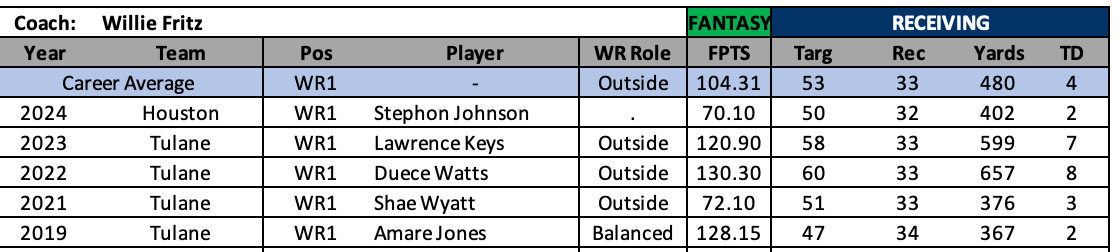
Amare Thomas’ 235 points this past season smashed Fritz’ previous WR1 PPG record. There was no precedent for this kind of thing in this system, and thus it is surprising to see Thomas’ success.
But as it happens, he has carved out a role for himself and transcended the system. So while this isn’t a classic stack duo combination from a CFF perspective, there’s enough potential here to warrant some consideration as a drafter this summer if you’re wanting to invest heavily in this Houston offence.
Last year’s starting RB, Dean Connors, moved on. He’ll take with him 42 targets. Connors sort of has a unique profile as a RB—kind of Max Borghi-esque, for those who get the reference—so maybe those targets end up funnelling back to the WRs in his absence, or maybe Houston finds another pass-catching RB to start this fall. Hard to say this early out. As things currently stand, Makhi Hughes looks to be the favourite to be RB1, and pass-catching has not been a big part of his profile thus far.
On average, Fritz’ teams will skew heavy run. The closest to a balanced ratio a team under him has finished was the aforementioned 2021 Tulane team (45/55 to the run).
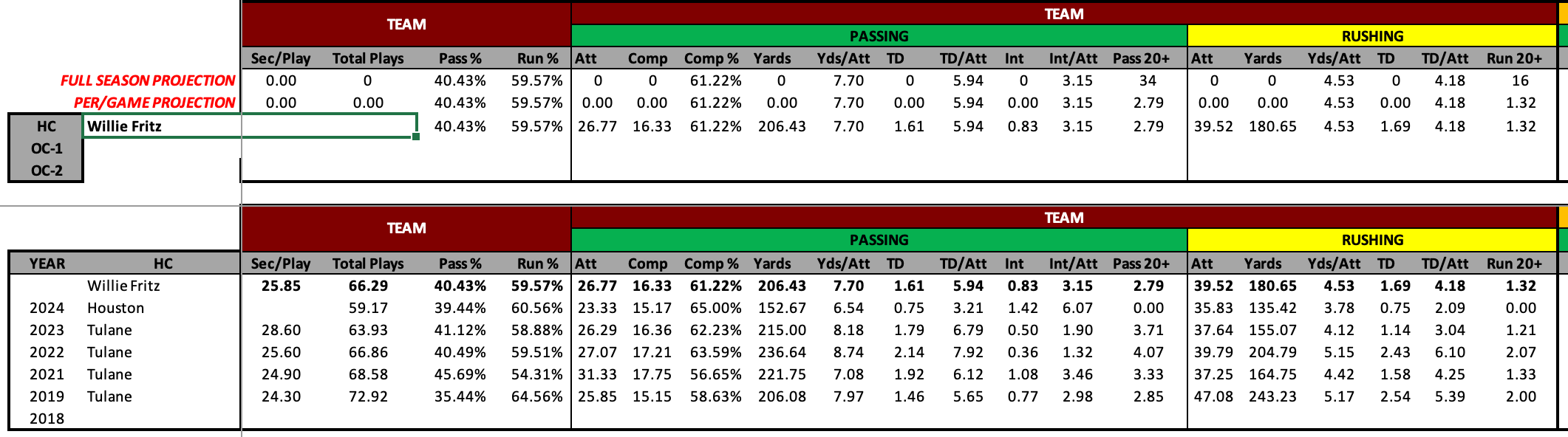
So once again, you can see my point that this system is not really one you’re typically looking at as a CFF stack goldmine. The QBs have been able to be successful as dual threat options, but until this year there was not a WR worth rostering in CFF, let alone an elite option.
What (sort of) saves the scheme in a CFF context is that the pace of play calling is usually pretty good, hovering around average for the FBS level at ~25 seconds per play, though in 2023 Fritz slowed things down pretty dramatically at around 28 seconds per play (see Table 2.).
This past year Houston finished with an average of 26.6 second per play, which ranked 77th in the FBS. Certainly, things could be better on this front, but I was expecting worse prior to writing this article.
Making the Case for Amare Thomas
Well, TDs matter a lot in CFF scoring, and Amare gets a lot of them. Normally I would say that this will correct itself (not in a good way), but he’s done this for two seasons in a row, and with two different offences. Even if he were to surrender some targets to Walker, it’s hard to envision a Houston offence that isn’t looking his way in scoring positions often.
Especially considering he was one of the core three players who Houston immediately re-signed after their bowl game for 2026. I think it’s safe to say Amare is squarely in the plans for next season. And whenever there is an already established connection between QB and WR (especially in today’s age of player movement), that’s always a plus too.
I have said all I need to say at this point about the system. I think between this article and the last one I did back in December, readers are well aware of everything they need to know about the Fritz-Nagle offensive philosophy.
But what is also true is that Amare Thomas has established himself as system-breaker (a rare commodity). So, while I always like to paint the full picture of the infrastructure around these players, perhaps, in this case, it is not so important. Indeed, Thomas already obliterated this systems’ previous record holder at WR in PPG. So who’s to say he can’t do it again?
From a wider lens, Houston is well positioned to be one of the better teams in the BIG12 in 2026. That doesn’t mean that they will be, but continuity on offence tends to pay dividends on the field. And more scoring = more opportunities for Amare Thomas (and others) to net CFF points.
His system breaking heroics aside, it would be truly wild if Amare Thomas manages to finish as a top five WR in CFF given the historical precedent of the system he plays in. I currently have him rated as the #5 WR in my CFF rankings but that is more based on his floor and my confidence in him being at least ‘good’ this year, rather than a pure categorization as the fifth best WR.
It’s more like: he is the WR that I’m fifth most confident in being a good CFF asset for 2026, not that I think he’s going to be top five in scoring when all is said and done.
But we’ve seen wild things happen in CFF before! And there aren’t a lot of other established WRs returning with the same QBs in 2026. A top ten finish feels well within reach and I think that alone justifies Thomas’ late first/early second round ADP. ◾
If you enjoyed this content and would like to read more, I recommend joining the Pigpen, a community of thousands of degenerate college football fans:
Sample from 2018-2024, excluding 2020.