Pigs of Tomorrow: Taking a Look (Finally) at C/O 2026

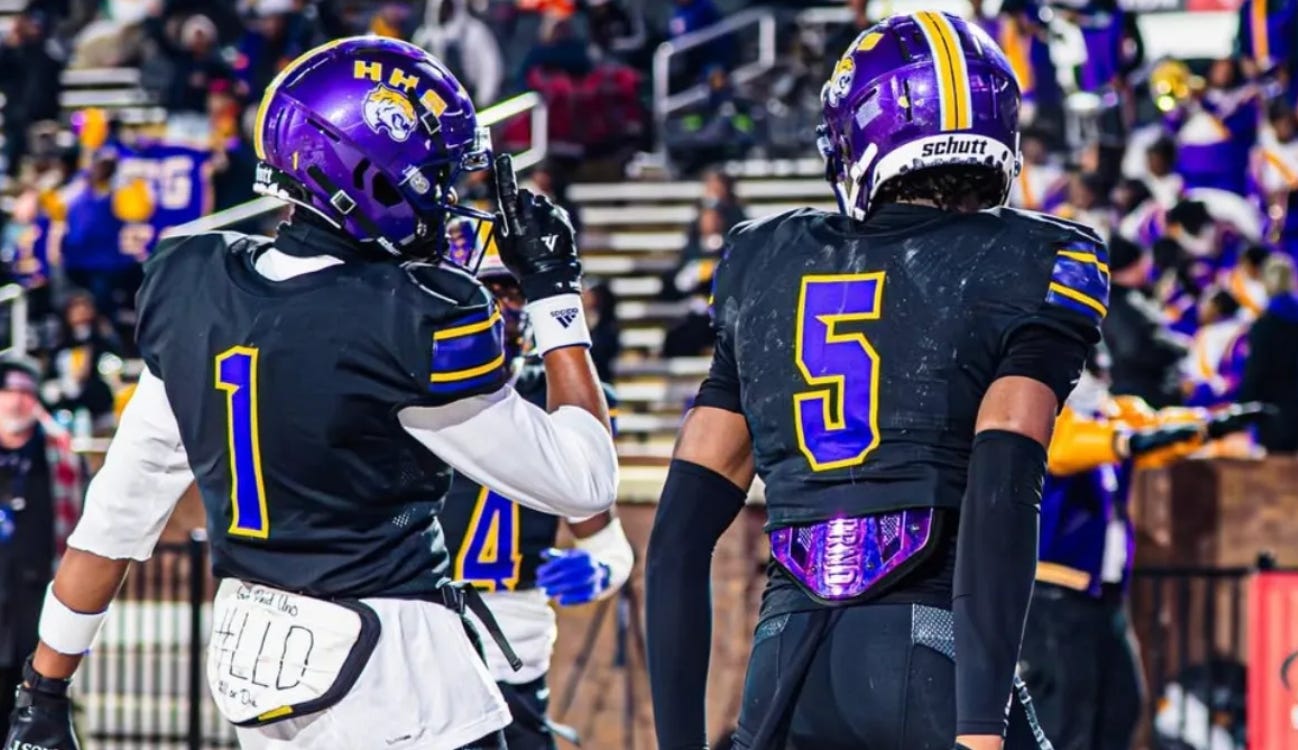
Ya’ll want to win, put Boobie in.
- Boobie Miles, Friday Night Lights (2004)
We finally got around to taking a look at the upcoming class of freshman for 2026 (C/O 2026). One immediate observation is that there is a growing trend of reclassifications in high school football. In this cycle, at positions RB, WR, and TE, one of, if not the top rated player in 2027, reclassified to 2026. All three of those players are covered in this article.
While it is my opinion that NIL chaos is generally undesirable for the product of college football, one of the positive externalities of this Wild Wild West era is that we can use NIL investment as an indicator for potential future CFF value.
There are multiple players in this article that—through reading the tea leaves—were some of the highest paid players in the cycle, and might even be some of the highest paid players on their new teams when they arrive on college campuses.
As with any iteration of these articles, the chance of any freshmen player playing significant snaps in year one is low, and the chances of someone such as myself identifying who those few will be ahead of time is even lower.
Furthermore, I try not to highlight only a bunch of chalk entries but rather delve into some of the more under-the-radar guys as well, which of course makes the exercise even harder. The lower rated prospects are in the second half of the article (for paid subs).
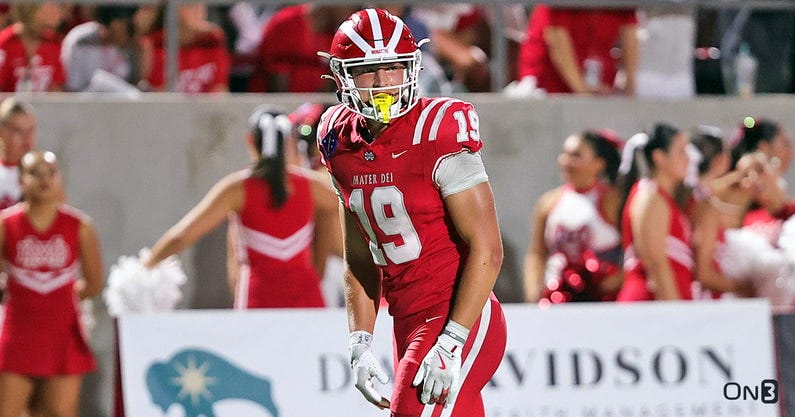
Mark Bowman (USC), 6’4, 230
These lists are hard enough as it is that I usually try to stay away from TE prospects. But the circumstances around Bowman’s recruitment were enough of an indicator to me that he’s probably going to be involved in year one (unless he shows up and completely sucks ass, which is always possible but I don’t think likely here).
Georgia, Texas, and USC were the three main competitors at the end, but ultimately Bowman opted to stay home. The comparisons to a former UGA great were obvious early in his recruitment, with him wearing #19 specifically and playing TE in the state of California currently.
And that’s where NIL as an indicator could come into play here. Bowman is reportedly one of the highest paid players in the C/O 2026, and is the gem of USC’s massive recruiting class.
Mater Dei high school has proven to be an incubator for future P4 players over the last decade plus, and this past cycle was no exception with four Monarchs in the top 10 of California rated prospects.
Interestingly enough—as has become customary in modern day recruiting—USC only signed two out of the top 10 players in California this past cycle, with the other being Mater Dei’s WR Kayden Dixon Wyatt.
Bowman is actually a reclassified player from 2027, but the fact that he was still rated a five star in this cycle speaks to his perceived talent by the industry. “Baby Brock” I believe was a nickname that was thrown around earlier last year. I suppose, we can still use the nickname, he looks very similar to Bowers, even if he’s going to wear a USC jersey in college (for now, at least).
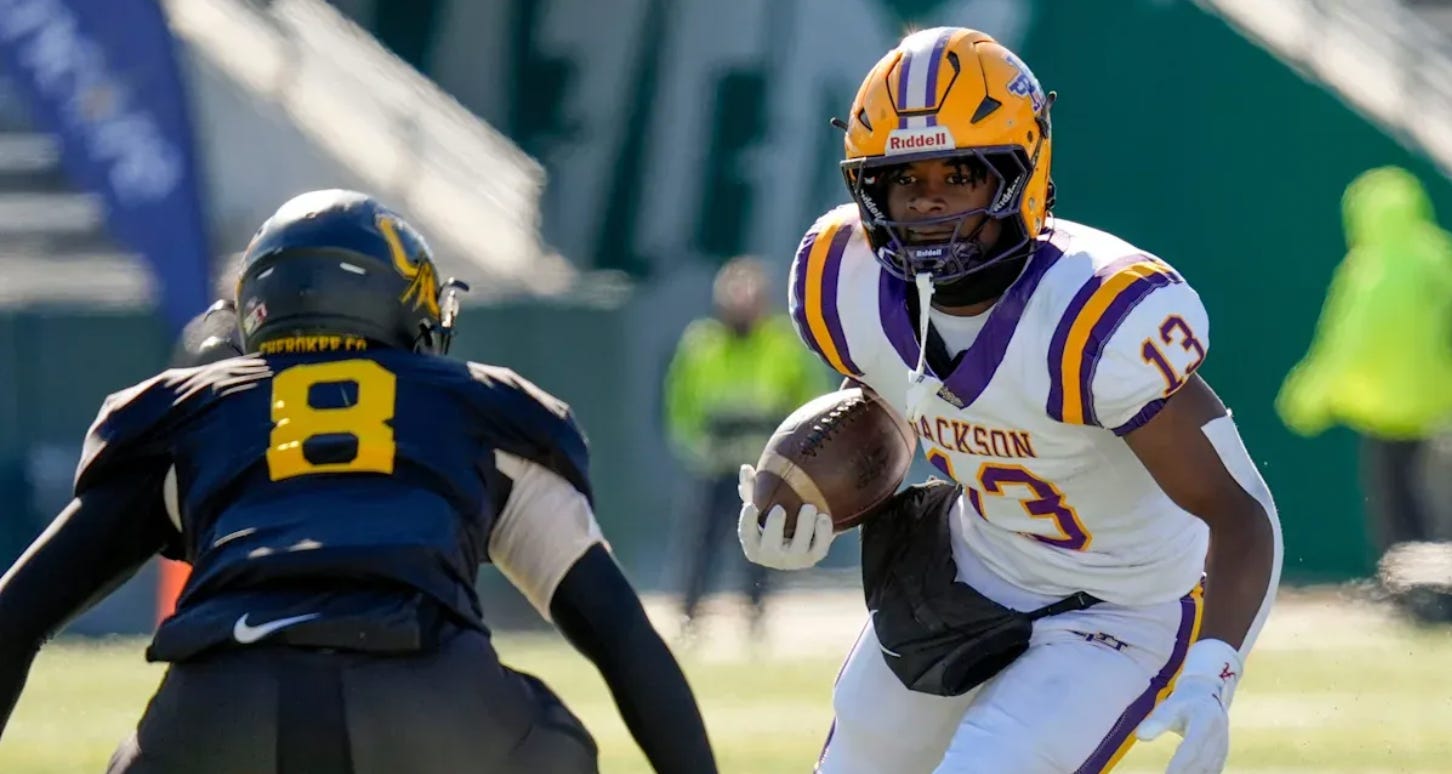
Ezavier Crowell (Alabama), 5’11-210
Perfectly sized already (if listed is accurate, which ON3 says it is), the best thing that could have happened for Alabama’s incoming five star RB is Daylen Smothers’ late flip to Texas in the portal. “Late flip” and “portal” in the same sentence still reads wrong, but who’s counting.
The recruiting industry was unanimous in slotting Crowell behind their #1 rated back, Savion Hiter, but #2 isn’t so bad, and the actual mathematical difference in scores is insignificant.
Crowell has verified track times, including a 10.7 100M dash time, suggesting he possess great speed in addition to a CFB workhorse-ready frame coming out of high school. Initially I was concerned that he had re-classified from ‘27, but later found out that this is actually the class he should have been in all along (I guess he has a late birthday, or something).
AK Dear was one of the prized recruits for Alabama last year and is expected to be the one who steps up the most in the absence of an elite portal acquisition. Beyond him, Daniel Hill and Kevin Riley are still kicking around. Nonetheless, it’s safe to say that, as far as upper tier P4 programs go, this backfield has one of the easier paths to the field in 2026.
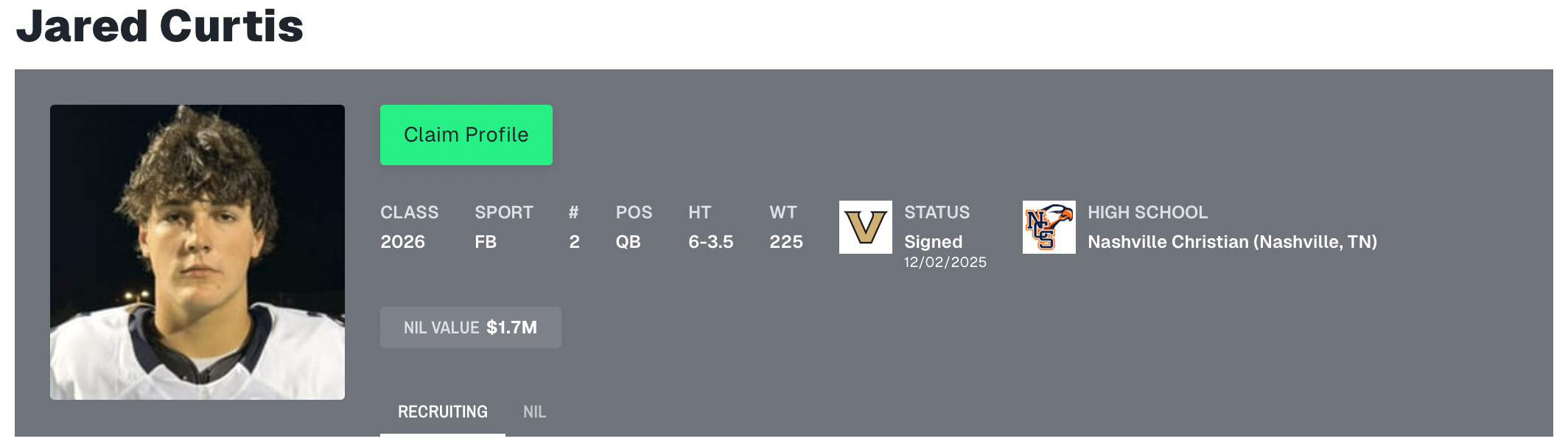
A late flip from UGA, I’m guessing Curtis’ camp were sweating bullets when former Vandy QB Diego Pavia and his team were pushing for an eighth year of eligibility or whatever it was earlier this offseason.
After all, supposedly a big part of the motivation to flip to the Commodores was so that Curtis, the #1 rated QB in C/O 2026, would not have to sit in year one behind somebody like… Gunner Stockton. Obviously, this line of logic worked out great for the last guy, Dylan Raiola, who’s currently holding Dante Moore’s jock strap in Eugene, so who can blame Curtis?
I think with QBs, especially the ‘five star’ rated ones, the expectation has to be that they will hit the transfer portal at least once. It’s much more likely Curtis will finish his career somewhere else, whether he ended up signing with UGA or Vandy, than it is that he leaves college as a Commodore. Maybe that changes as the NIL era matures, or maybe it only further exacerbates the issue, only time will tell.
But for now, I think it’s safe to say that the red carpet has been laid before Curtis’ feet, with the hope and probably expectation in Nashville that he’ll take the proverbial baton from Pavia and run with it. “Run with it” bring more literal than I originally intended, as Vandy are losing a lot of senior players from the 2025 roster, including along the offensive line.
Will Curtis play a lot in 2026? I would think so. Will he be any good? That’s a different question. I’m not sure there will be a lot of support around him. Hopefully that doesn’t send him on a Raiola-esque trajectory for the rest of his career.
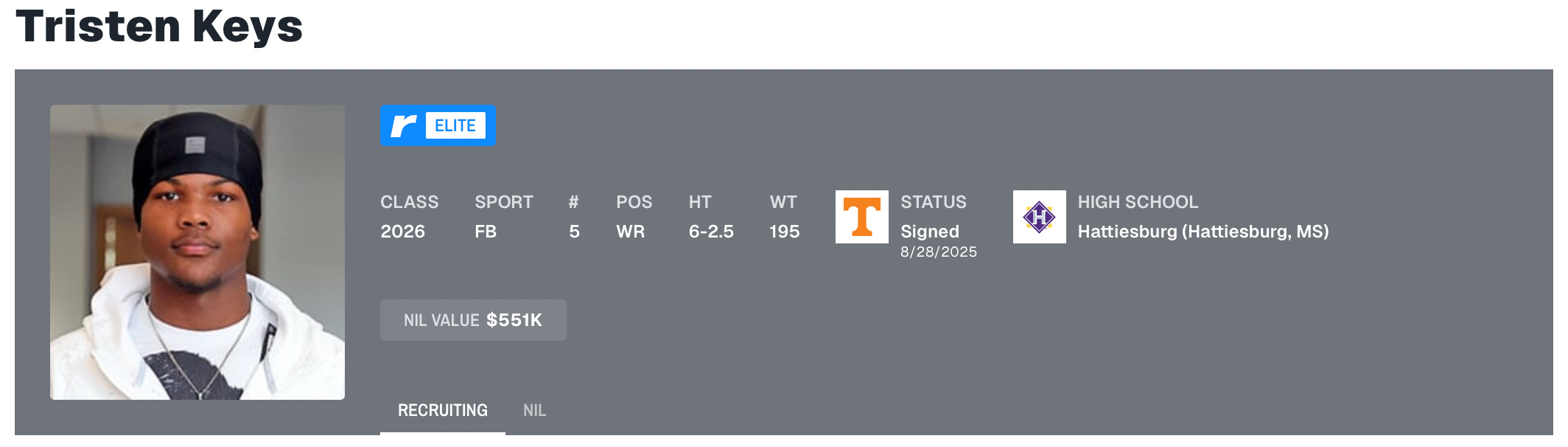
To my untrained eye, Tennessee’s five star signee at WR was not only the best looking one of the bunch this year, but one of the better looking players of the past few cycles based on his junior season tape.
Admittedly, I have not gone back into the archives to see how he fared in his senior campaign, but I assume it was much of the same. And I have to say, Mississippi as a state is so underrated when it comes to WR production. They punch way above their weight in this asset class, seemingly producing a high-end WR prospect every year, which is pretty absurd given how poor and unpopulated the state is.
Keys was originally committed to LSU, but later flipped to the Vols to play in Josh Heupel’s system. I’m not sure what advice these guys are getting, but they ought to take a look at the track record of Tennessee’s WRs in the NFL. LSU, even under the old regime, seemed to be a better move in my humble opinion, but what do I know?
Even a place like UGA, who everyone rags on for not having a 1000-yard receiver since like, 2001 or whatever, has more recent WRs in the NFL who are actually balling (Ladd McConkey and George Pickens) than the Vols.
Nonetheless, as far as we’re concerned as CFF players, the move to Tennessee is a good one. This system has a knack for sustaining (at times) prolific WR numbers, which is always good for CFF.
Mike Matthews and Braylon Staley are expected to be the top two receivers in 2026 and I’m plugging both in as starters even as we stand in March. Keys can probably earn a role as a rotation guy later in the year if everything works out well for him. Year two will be the bigger impact year for him most likely.