
RAVE TIME MACHINE

Some motherfuckers are always trying to ice-skate uphill.
- Blade, Blade I (1998)
It is the year 2026, and despite what 80s sci-fi films would have had you believe, we do not yet have access to time machines. Maybe it’ll happen in some of our lifetimes. Probably not.
But it is fun to fantasize about. If I had a time machine, there are several timelines that would be at the top of my list for a vacation. Certainly the 80s would have to be in there. I want to rock a mullet and letterman jacket in some small town in Nebraska.
The 90s are also appealing in a different, more grungy way. I want to be on a lot of drugs—in Berlin specifically—and partying at a rave the way it was meant to be done. I imagine it being a really intense experience. Did they even have testing kits back in the 90s? How TF did these animals manage?
Similarly, from a CFF perspective, a time machine would certainly come in handy when looking at recent trends of RB usage. 300+ carry gangsters used to be ubiquitous throughout the sport (there have even been some 400+ carry RBs). Recently, there have been years without a single runner hitting the 300 carry mark. This is disturbing to anyone with at least half a brain.
But as with all movements throughout history, there are a few revolutionaries who lead the resistance against this change. Great men who stand up for what is right in a dark era of perversion within college football.
Below you can find data provided by Joe Arpasi on some of the most RB friendly systems over the past five seasons using carry share as a primary metric:
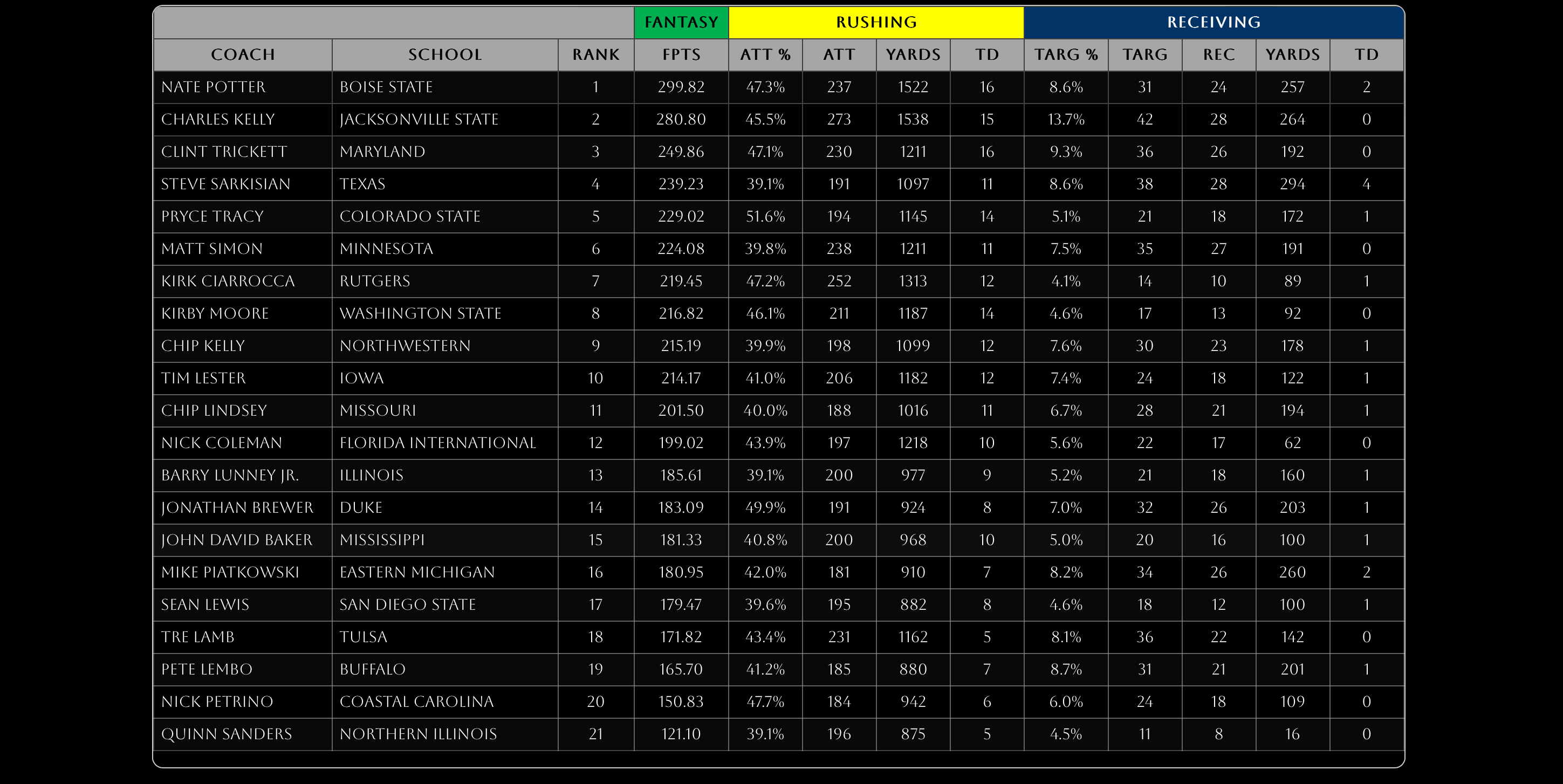
With some of these coaches at the helm, it does almost feel like going back in a time machine to a bygone era of collegiate football. Ultimately, it should be no secret by now (and certainly not to the readers of this publication) that more volume = more production.
So, as we prepare ourselves for the college fantasy football (CFF) season, we should be mindful of which staffs have a demonstrated history of feeding their RB1s the most.
The problem with this current list is: most of these backfields do not have a clear bellcow entering 2026.
I would say with the exception of Kirk Ciarroca at RU, Matt Simon at Minnesota, John David Baker at Ole Miss, Jonathan Brewer at Duke, Sean Lewis at SDSU, Chip Kelly at NU, and Chip Lindsey at Mizzou, the rest of those backfields do not have clear returning pigs for CFF managers to anchor to.
NATE POTTER AT BSU. Potter and Danielson had a smashing first season with Ashton Jeanty demolishing college football, but in their first season without #2 they largely ran a committee. Both Sire Gaines and Malik Sherrod split work to open the year, and then midway through the season Gaines and Dylan Riley traded stellar performances back and forth.
At the very least, when Gaines and Riley were splitting work, one would get the bulk of carries in one game, and then the other would receive them in another game, which allowed each to have strong performances.
That can work just fine in best-ball scoring, but in standard formats, that’s a big no-no. Trying to predict when one of the two runners will be the main guy is a fool’s errand, and the result of that question is probably mostly influenced by whoever is carrying the ball better on the day, so it isn’t even predetermined information that you can get a scoop on beforehand.
I expect much of the same this fall, and we can add in Pitt transfer Juelz Goff and KU transfer Harry Stewart.
CHARLES KELLY AT JACKSONVILLE STATE. It’s a complete mystery what’s going to happen in this backfield this upcoming season. Not only do we have the question of whether there will be a bell cow with a new OC being promoted from within, but who that would end up being even if there was one.
There really is no inside scoop to suggest one way or the other, but Khristian Lando was a young player last year who got some major run. He and Justus Savage split work in JSU’s bowl game when the FBS leading rusher Cam Cook sat out. Either is a good bet to take on the lead role, as is former UGA transfer Andrew Paul, following a rather uneventful freshman season.
Lando is probably the one I like the most purely on ‘vibes’, but Savage is another one that is appealing and was supposed to have a bigger role last season if my memory serves correct from this time last year.
CLINT TRICKETT AT MARYLAND. Pig Master Trickett has taken his talents back up north to the Mid-Atlantic. He knows this region well. Prior to JSU he was with Charles Huff at Marshall, where Trickett’s pigs ate early and often.
It is only logical then that CFFers have anchored (rather heavily) into returning rusher DeJuan Williams. I fear that Mike Locksley simply will not countenance a RB seeing 300+ carries in a season, but given that Williams was used so much as a receiver last year under the old OC, one has to think that the Pig Master will find a way to get DeJuan’s total touches above 200, which is good enough in today’s CFF world.
STEVE SARKISIAN AT TEXAS. Sarkisian’s KDPF1 license was recently revoked this offseason. I wasn’t happy to do it, but somebody had to. Being the sheriff in town isn’t always about being Mr. Popular, ya feel me?
It’s been two years since Sark had a rusher handle grown man work out of his backfield and his latest hi-jinks bringing in both Raleek Brown and Hollywood Smothers (who were both great as CFF assets at their last stops), was enough insubordination to warrant the revoking of his license. This fucking guy is out of control.
Specifically, if we go back in time for a moment—Hollywood Smothers was ALREADY committed to another program where he would have been the clear lead dog. In this hypothetical world where he stays, we would have had TWO more monster profiles coming into the fall from a CFF perspective via both Raleek Brown at Texas and Hollywood at Bama.
So what are they going to do with these transfers this year? Is it really a mystery—probably rotate both. Yuck. It works in bestball but not in standard formats.
PRYCE TRACY AT COLORADO STATE. Tracy and Jim Mora are coming over from UConn, where their lead pig Cam Edwards finished as a top 20 CFF RB.
Former UConn Husky Mel Brown has received praise this offseason, but that was with former Husky and Auburn RB Durrell Robinson sitting out with an injury. Will Brown retain his place in the hierarchy now that all the dogs are back?
Hard to say. When I wrote about Brown a few months ago I declared that even if he is the RB1, I am not expecting a season like Edwards’. I still stand by that claim.
KIRBY MOORE AT WASHINGTON STATE. Kirby Vorhees is the one most people expect to be the lead runner, but it is not yet clear how valuable that will end up being in the CFF world.
Reports out of Pullman have repeatedly mentioned a “three-headed monster” with Maxwell Woods, and Leo Pulalasi behind Vorhees.
Moore is coming over from Mizzou where he had Ahmad Hardy and (I believe?) Cody Schrader. Prior to that he had Jordan Mims way back when at Fresno under Jeff Tedford in 2022.

I wrote about this backfield earlier in the offseason and my stance largely remains the same: a good backfield to monitor as the season progresses on coaching pedigree alone but hard to justify anchoring into one player at the moment.
TIM LESTER AT IOWA. Lester’s presence at Iowa immediately turned the tide on their CFF outlook as each of the last two seasons there have been CFF relevant RBs.
In 2024, it was the illustrious Kaleb Johnson, who absolutely torched the B1G with over 20 TDs. Last season wasn’t as explosive, with Kamari Moulton leading the charge as the weapon of choice.
Had Moulton returned with no major transfer, he’d be a popular pick this offseason in CFF drafts. Unfortunately for him (and us), one of the most productive RBs from the FCS, LJ Phillips, will be joining him in the Hawkeyes backfield this fall.
With both in the fold, it’s hard to pick one as a definitive option to be a bellcow, regardless of who ends up starting. Personally, I have a hard time seeing Kirk Ferentz unseat a returning, veteran, starter. So, I’d expect Moulton will take the first carry to open the year.
As with all the situations where there are two runners expected to be heavily involved (e.g., BSU, Texas…), if one goes down, the other could go ballistic.
If you enjoyed this content and would like to read more, I recommend joining the Pigpen, a community of thousands of degenerate college football fans:
The Known Degenerate & Avid Pig Farmer license, sometimes called the Known Degenerate Pig Farming License (KDPF) for short, is a prestigious designation granted to those coaches who have demonstrated mastery and high competence in the art of volume distribution within their backfields.