
FARGO
Announced this past weekend was news of North Dakota State joining the FBS effective immediately in football. VP took a look at who CFFers might want to know ahead of time...

The shallow end of the pool is where the turds float.
- Varga, Fargo (S3, TV)
Did you know the human eye can see more shades of green than any other colour? It’s probably for the best considering the FBS will be welcoming yet another program donning green on their jerseys—the North Dakota State Bison.
Following years of suggestive discussion, NDSU and the NCAA finally pulled the trigger on what could be a match made in heaven this past weekend, announcing a move for the FCS’s most successful program to the Mountain West Conference (MWC).
As for me, I was taking in a crisp skate on Ottawa’s famous Rideau Canal when I found out about the news. A short breather on an unoccupied bench seemed a good idea at the time—though it didn’t take long for the cold to make its way into my bones. I subsequently made my way back to my lodging where the last slice of a chocolate pie was awaiting me. The crust was made out of Oreo cookies, and was delicious, but sometimes proved difficult to remove from the pan.
I wrangled with the final slice and successfully managed to transport three quarters of the contents into my plate. The following few minutes involved a sobering negotiation with myself, before succumbing to the realization that I neither had the skills nor the inclination to unearth the final section of pie crust from its original accommodation.
I then sat down—three-quarters of pie in hand—with designs on catching up to the news of the day.
There was understandably a mixed reaction to the FBS’s latest acquisition. For context, NDSU was basically the FCS equivalent of Saban’s Alabama dynasty, except even more hegemonic. They had won ten FCS national championships out of a possible 15 dating back to 2011, including a run of five straight from 2011 to 2015. Read that line again if you need to.
The level of success they attained, and sustained, was unprecedented in college football. And for many, their presence in the FCS was becoming boring.
Boring both for NDSU, who oftentimes found themselves playing with their food, and boring for other fan bases who (correctly) deemed that outcomes of many seasons were predetermined. A move to the deeper end of the pool arrives at a fortuitous time, in my opinion, though I will miss NDSU’s rivalries in the FCS. There is a romantic charm to the idea of an entire division of CFB being dominated by the Dakotas and the Montanas.
NDSU had both a 1000-yard RB and WR last year in only 13 games following an upset loss to Illinois State in the FCS playoff. Long story short: they don’t return either player. Nor does the starting QB who threw 16 TDs and ran in another 13 return.
The younger brother of the departing RB (Barika Kpeenu), named Barry Kpeenu, does return, but he didn’t do much last season. The player I am actually interested in is the true RB2 from 2025—DJ Scott, not to be confused with the “Duke” Scott from NC State (in case that name seemed familiar at RB).
Scott ran 95 times for 502 yards and six TDs. Only he and the starter saw more than 30 carries in 2025. We’ll get more into personnel shortly.
I haven’t had a pie like that since the Garden of Eden.
- Lorne Malvo
COACHING & SYSTEM
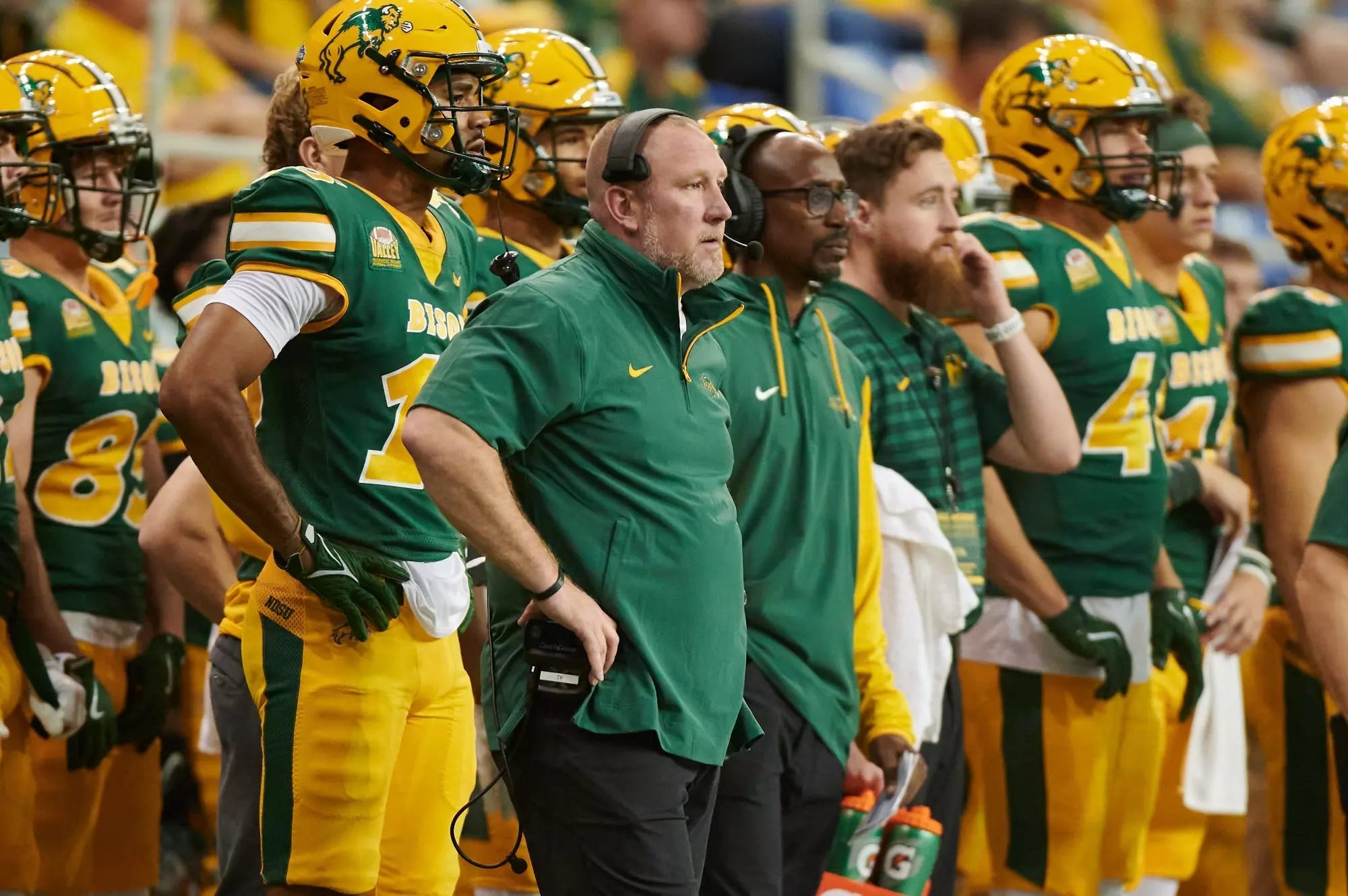
Another thing you’re probably wondering about is the staff. Tim Polasek is the current head coach of NDSU, and his OC is a man named Dan Larson. Below is a summary of Polasek’s RB1s during his HC/OC stops in Div. I football dating back to 2014:
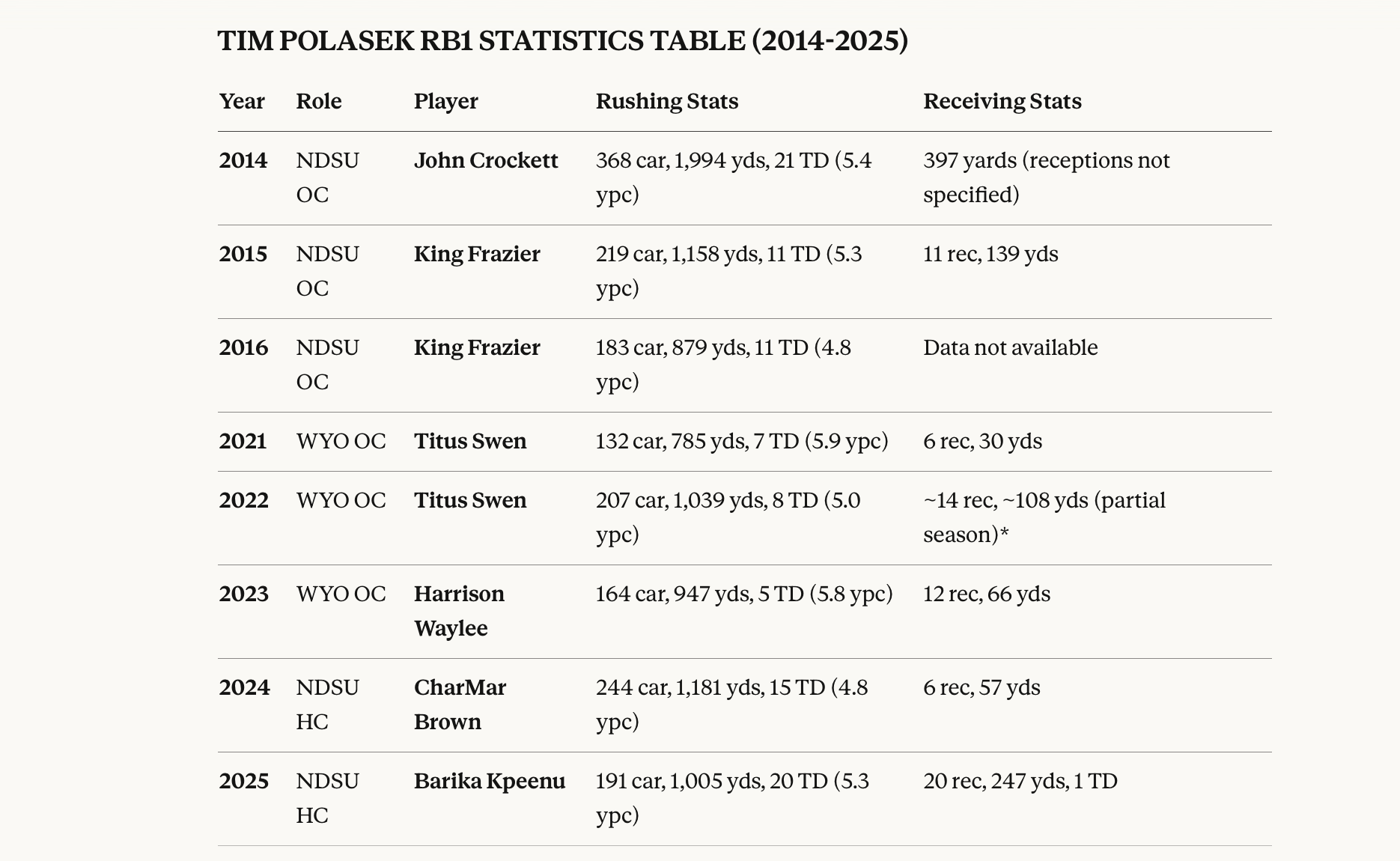
Over eight seasons with Polasek as OC or HC, his RB1s have averaged:
Rushing: 210 carries, 1124 yards, 12.3 TDs, 5.2 yards per carry
Receiving: 11.6 receptions, 122.8 yards (when data available)
Six of eight RB1s surpassed 1000 yards total
ClaudeAi wasn’t able to retrieve King Frazier’s 2016 receiving stats, but a cursory look on NDSU’s website revealed he caught four passes for 18 yards.
Also keep in mind that a lot of the players included in the table above played in up to 16 games, since NDSU was frequently going the distance in the FCS playoff (2014, 2015, and 2024 teams won the championship).
The John Crockett years were legendary in Fargo. Now-retired and former KSU head coach Chris Kleiman (who is still held in high regard at this publication) was the head man for the Bison back then. Polasek became the coordinator on offence in 2015. Dig this: Crockett ran for over 1000 yards in all three of his collegiate seasons (2013-2015). Too bad NDSU wasn’t part of the FBS back then, am I right?
Especially if they were to be in the Mountain West. I’m not under any delusions that NDSU will pick up right where they left off in their first year of FBS football, particularly from a RB YPC efficiency standpoint, but I don’t think there will be a big adjustment needed playing in a now-watered down MWC either. I mean, is there really a big difference between some of those animals in the Missouri Valley Conference and the New Mexico Lobos?
The OC, Larson, who you’re also probably wondering about, was promoted to that role in 2025. Previously, he had been the OL coach in Fargo since 2019. Old CFF wisemen will tell you that the OL coach being anywhere near play calling responsibilities is often a good omen for the RBs.
Larson was the head coach of something called Wisconsin-Eau Claire before making his way over to Fargo. This is perhaps where my Canadian background comes in handy with my French translation skills: Eau is ‘water’ and Claire is ‘clear’. So this team’s name literally translates to Wisconsin-Clear Water in French, which I’m not sure I fully understand what’s going on here but I do like it.1
Before Clear Water, Dan Larson was—get this—the OC at Minnesota-Duluth. Sometimes these articles just write themselves, I tell you. Minnesota-Duluth are a Division II. school and were fairly successful during Larson’s tenure.
I can keep going but I think you get the gist of Larson’s background. This man moves around the midwest more than Lorne Malvo and I’m starting to get suspicious.
Though as long as his RB1 scores 20 rushing TDs in a single season, he’s all square with me. As of writing, both Larson and Polasek are slated to return to the Bison in 2026.
On a cursory look at last year’s individual stats, it appears that this NDSU team were run-heavy in 2025. The QB attempted a total of 225 passes, while running 136 times (second only behind RB1 at 191 carries). The RB1 carry figure isn’t ideal, but we can work with this.
Bryce Lance led the team in receiving, and did hit 1000 yards despite relatively low pass volume.
The year prior it was now-Miami RB CharMar Brown who carried the squad with 244 carries (16 games), 1181 yards, and 15 rushing TDs. Bryce Lance once again led the team in receiving with 1053 yards (again, this coming in 16 games).
QB Cam Miller passed for 3251 yards, 33 TDs and only four INTs. He also rushed 145 times for 718 yards and 12 scores.
PERSONNEL
As mentioned above, the QB (Cole Payton), is moving on. I’m not familiar enough with the backup personnel to declare whether there will be another dual threat runner starting at QB in 2026. Though judging from Polasek’s past, it seems that is his preference.
Nathan Hayes was the player taking snaps behind Payton last season, and he finished with 25 completions on 44 attempts for 381 yards, four TDs to one INT. He ran a total of seven times for 88 yards and one score. He returns this offseason and I would (ignorantly) handicap him as the favourite to win the job.
The only other QB who attempted a pass was a man named Trey Drake (1-1, four yards). He also returns to the club for 2026.
This is a tidbit from the Bison’s fall camp last offseason:
Payton will be pushed by junior Nathan Hayes. The 6-foot-3, 219-pound backup got invaluable experience last season after Payton went down. Regarded by Miller as having the best arm on the team, Hayes showed that in spurts last year, with a couple of impressive throws in mop-up duty against Murray State and Missouri State. Hayes also displayed some impressive speed, scoring on a 51-yard touchdown run against Tennessee State.
Polasek has been complimentary of Hayes and his potential running the offense. It bears watching on how the Bison will try to find ways to get Hayes on the field.
The Miller referred to in there is Cam Miller, the former NDSU QB that won a natty in 2024.
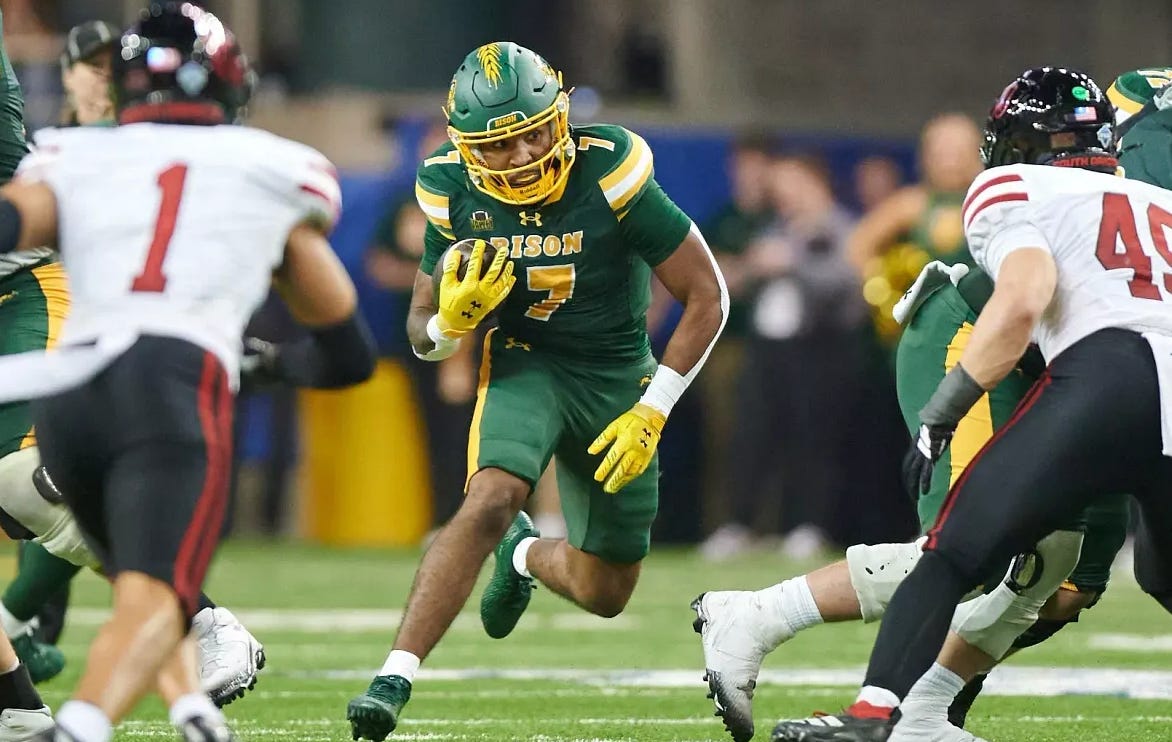
At RB, I’ve already mentioned a name I’m interested in—DJ Scott, who will be entering his fourth year of CFB coming out of Oviedo, Florida. Those familiar with me know I have a positive predisposition for Florida-based players when it comes to CFF.2 Especially at the RB position.
Scott is listed at 5’11, 206 pounds, which is a pretty prototypical FBS RB1 build. Behind him was Cortez LeGrant (25-131-0) and Myles Mitchell (18-78-1). Both of those players return as well. LeGrant is a 5’10, 190 pound redshirt sophomore (or junior?) from Sun Prairie, WI. Mitchell a 5’9, 195 pound redshirt freshman from Illinois.
I’m starting to like this outfit the more I learn about them—a few splashes of Florida here and there where needed, but mostly it’s just a collection of rural midwestern goons. That’s gangster.
Notably—and the reason I added a question mark on Mr. LeGrant’s eligibility—is because he started his career as a preferred walk on (PWO) at Minnesota, and was apparently there for two seasons (presumably burning through redshirts and NOT spending enough time at PJ’s cottage) before appearing in nine games for the Bison this past season.
Just like the FBS, the FCS is not immune to frequent transfer activity on their rosters. DJ Scott himself started his career at now-FBS program Kennesaw State (2023-2024). I’m seeing that he only took two carries in two years with the Owls and is also listed as a sophomore—like LeGrant—on ESPN. I would think he is a rising redshirt-junior, same as LeGrant, but I’m not entirely sure.
At WR the Bison must replace their go-to guy in Bryce Lance, who caught 51 passes for 1079 yards and eight scores in 2025. The next leading receiver was RaJa Nelson, who also appears to have finished his career in Fargo last season.
The third leading receiver was Reis Kessell, who is returning at the TE position. Though, he only caught 15 passes for 335 yards and one score as the third man on the totem pole.
Jackson Williams was the third leading WR and he actually does return after a 17-293-1 season.
Lance is listed at 6’3, 210 pounds, so I’m going to take a shot in the dark and suggest that he was a boundary receiver in the offence. Nelson is listed 5’9, 196, while Williams is 5’11, 183. So teasing out who played in the slot isn’t as clear.
On one hand, if Williams is reprising his role in the slot, it’s probably incumbent on the prospecting CFF manager to inquire about who will be on the boundary in Lance’s stead for 2026. On the other, if Williams was one of two on the outside last year, then that creates an entirely different narrative for his outlook in ‘26.
If you were expecting me—someone who didn’t know who any of these guys were 45 minutes ago—to give you an answer here in February, then you’re sorely mistaken.
Of course, I will continue to monitor this situation, but I will also say that on the whole, looking at head coach Tom Polasek’s career, WR production is not his forté (the accent on the ‘e’ isn’t necessary for this word in English, but I did want to ensure you were pronouncing it this way in your head when reading this passage, and also because it creates a nice call back to that French Wisconsin school earlier—HON HON HON, I have my hand in a lot of pies!).
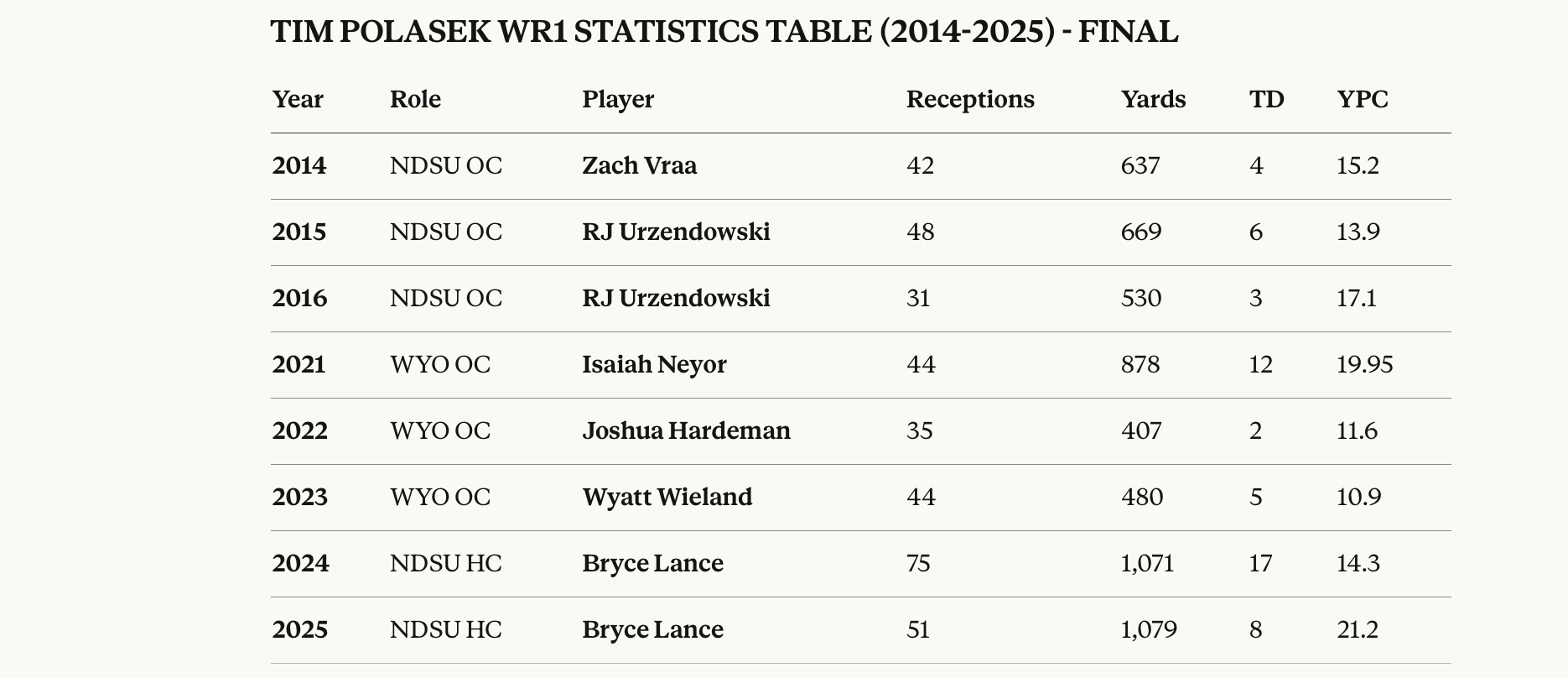
Notes:
Zach Vraa played in 13 of 14 games in 2014 due to hamstring injury
Isaiah Neyor’s 2021 season: Led Mountain West in yards per catch (19.95) and TDs (12)
Bryce Lance’s 17 TDs in 2024 set NDSU and MVFC single-season records. Lance also had school’s 2nd-most receptions (75) and 3rd-most yards (1,071) in a single season
Lance seems to be somewhat of an anomaly in this capacity, becoming Polasek’s only WR1 to hit 1000 yards, and doing it twice in as many seasons no less.
However, it’ll still be worth keeping an eye on to see what the word is coming out of spring/fall camp regarding the WR hierarchy.
My antenna will primarily be aimed at the tailback and quarterback positions. Both spots produced what would have been lucrative assets to hold had they been eligible for CFF managers in the FBS over the past two seasons.
There are no saints in the animal kingdom. Only breakfast and dinner.
- Lorne Malvo
Overall, I feel quite optimistic that NDSU will be capable of facilitating CFF relevant players readily in the FBS. The immediate success of lesser FCS programs at this level only serves as further evidence in my mind that the Bison should have a fairly seamless transition in the MWC.
QB is a question mark given that they are replacing their starter. Offensive line is the other major question mark. This would have been a point of almost-insurmountable strength for NDSU in their previous conference, and that understandably has trick-down effects in the run game.
One piece of good news is that Griffin Empey, who was voted on a pre-season watchlist for the MVFC, returns at right guard along the line. Whether he is actually any good (or even ended up starting all year) I could not tell you. As do week one starters Nate Tastad (LG), and Josh Magin (RT).
That is potentially three of five returning starters if indeed each of these lads started for the program in ‘25. My sources also tell me that rotational OT/G Ryan Babatz is highly regarded within the program.
When I was covering former NDSU head coach Matt Entz (2019-23) last year as part of the Fresno State preview, one of the questions was: what will happen with his offence if the efficiency in the run game is no longer dominant, or even above average?
In Entz’ case, his inherited offensive line at Fresno proved a calamity in 2025. This made things difficult for the Bulldog RBs to be productive. The offence ended up being not very good.
Polasek will at least have the benefit of bringing his program with him in 2026. I don’t feel that it is probable that NDSU’s offensive line will have difficulty acclimating, but it is one pressure point I’m interested in observing once 2026 kicks off.
Alas, it’s time to confront my nemesis and finish this chocolate pie once and for all. A revised strategy—direct fork-to-source drilling—has been devised. Wish me luck. ◾


If you enjoyed this content and would like to read more, I recommend joining the Pigpen, a community of thousands of degenerate college football fans:
Per Wikipedia: Eau Claire is the city in Wisconsin where the university is located. It took its name from Eau Claire County. “Eau Claire” is the singular form of the original French name, “Eaux Claires”, meaning “Clear Waters”, for the Eau Claire River. According to local legend, the river was so named because early French explorers journeying down the rain-muddied Chippewa River, came upon the confluence with the Eau Claire River, and excitedly exclaimed the contrast: “Voici l’eau claire!” (”Here is the clear water!”). Now the city motto, this appears on the city seal.