
NEW MONEY: The G5's Richest Program is a Potential Goldmine of CFF Opportunities
USF Football underwent a regime change this offseason. While there are more questions than answers currently, one thing is obvious: there are mucho opportunities for CFF value.

If you want to succeed you should strike out on new paths, rather than travel the worn paths of accepted success.
- John D. Rockefeller, business tycoon
The Industrial Revolution of the 1800s is undoubtedly one of the seminal moments of human history. Not only did it reshape economies, it created an entirely new social class in a very short amount of time.
For the first time in history, wealth was no longer the exclusive province of aristocrats and landed gentry. A generation of industrialists, railroad magnates, and oil barons—Rockefeller chief among them—built fortunes from nothing, earning themselves the label "new money."
A similar storyline is unfolding as we speak within the realms of collegiate football. Programs such as Texas Tech, Oregon, and Miami have found themselves on new footing within the hierarchy of the sport and have already begun reaping the rewards of their new status. And while the P4 may be the level with the most obvious examples of seemingly overnight transformations, they do not have a monopoly on the so-called nouveau riche programs of the NIL era.
The USF Bulls reportedly have one of, if not the Group of Five’s largest, NIL budgets, apparently boasting enough funds to max out the current revenue share cap of 20.5 million USD per annum. Impressive given that I’d imagine there are several P4 programs who cannot even hit that cap.
And I know I’ve mentioned this several times previously, but it never fails to amuse me how USF calls themselves the “University of South Florida” despite being located in Tampa Bay, which is definitely not south Florida.
I get why they do it—apart from “The University of West-Central Florida” sounding not nearly as cool—representing “South Florida” is just better branding, and probably confuses at least a few prospects each cycle when recruiting in Miami.
But let me offer you a brief history lesson first before diving into specifics—once upon a time this was one of the least thought of G5 programs in all of college football. Save for a strong two-year period in the mid-2010s, and a good start in the 90s under Jim Leavitt, the Bulls have largely been a mediocre G5 program since joining the FBS.
The most recent era of Bulls Football was a successful one, albeit perhaps not as successful as it should have been. Current Auburn head coach Alex Golesh took over the program following a prolific campaign as the OC of Tennessee in 2022.
During the next three years, he and QB Byrum Brown became the faces of the program; most notably gaining notoriety for running an incredibly fast and explosive offence. Defence was initially an issue in 2023, and to some degree, in 2024, but in 2025 the Bulls finally balanced out the competency of each side of the ball.
Unfortunately, they still dropped a few games this past fall against teams they were probably better than, and eventually missed the CFP, despite looking like the favourite to make it from the G5 following a victory over SEC program Florida earlier in the year.
A victim of their own success, USF once again ushers in a new regime in 2026. Former OSU WRs coach/co-OC Brian Hartline announced his move to take over from Golesh this past December, and he’s bringing former Coastal Carolina head coach Tim Beck with him. Unlike Hartline, Beck has an extensive history of play calling data to comb through (we’ll chat more about this in the following section).
In terms of personnel, USF needed to address several departures due to Golesh’s exit. The aforementioned QB Byrum Brown transferred to Auburn, as did WRs KeShaun Singleton, Jeremiah Koger, Chas Nimrod, and Christian Neptune. RB Nykahi Davenport also followed suit for good measure.
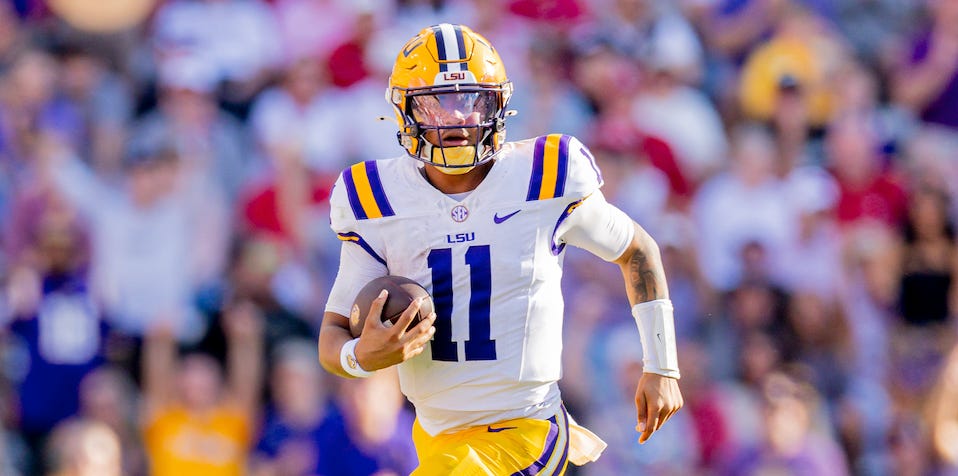
Firstly, at QB, USF brought in LSU backup Michael Van Buren and former MSU/FSU QB Luke Kromenhoek. Replacing the WRs are several intriguing names both as home-grown leftovers and transfers from elsewhere—namely UTEP’s Kenny Odom, OSU’s Bryson Rodgers, and VT’s Cameron Seldon (originally started at Tennessee), among others.
WR Mudia Reuben is the most productive returner from the 2025 season. JeyQuan Smith is another returning receiver who played significant snaps last fall.
It’s a similar story at RB, with a mix of holdovers from the previous regime, and a few notable transfers. We’ll get into details shortly.
First, let’s take a look at the newly hired architects of the offence.

COACHING & SYSTEM
PPG AVERAGE (HC/OC) — QB: 22/23 — RB: 15/11 — WR: 18/13 — TE: 5/41
As mentioned, former OSU WRs coach and co-OC Brian Hartline is taking over as head coach. He’d been with OSU since 2017(!), which was actually his first job coaching in CFB. He began his post-NFL career as a quality control analyst on the staff, and was eventually promoted to replace Zach Smith as interim WRs coach in 2018, and then eventually hired full time in 2019.
From a CFF standpoint, the results began immediately from the inception of Hartline’s tenure. Under coach Smith (2012-17), the Buckeyes had not had a single 1000+ yard WR. During Hartline’s interim season (2018), Paris Campbell became the Buckeyes’ first four-figure receiver of the decade with 1063 yards on 90 receptions.
Since then, OSU has had five 1000+ yarders in the following six full seasons (excluding 2020). The immediate takeaway is not that OSU began passing the ball more effectively, but rather that Hartline shortened the rotation of starters at WR. This has its pros and cons. Like with every player in CFF, the more they play the more opportunities they have to score; however, another way to frame it is more opportunities to get injured. The chance of injury increases exponentially with fatigue.
Still, I maintain that as a prospecting CFF manager this is the risk you’d rather take. Better to take the risk on something that can be good but may fail outright at some point, than aim low for a safe but mediocre asset. I think we all understand this.
Besides the obvious plus influence at WR, what does Hartline bring for other positions? I have more trouble attributing influence to him when it comes to the production at other spots since he was not the positions coach, and as the co-OC, he only had limited play calling capacity. We actually know for a fact that head coach Ryan Day would occasionally take over as the primary play caller. This muddies things a bit.
Looking at the Buckeyes’ offensive statistics at face value, however, one can surmise that the system Hartline might bring to Tampa will be a favourable one for both the QBs and the RBs as well. The Buckeyes moved away from extremely porcine bellcows in the 2020s, but they still featured multiple 1000+ yard rushers. The problem from a CFF perspective was more so that there was usually two players at RB who were splitting the work (e.g., 2024).
At QB the Buckeyes did not produce a game-changer in any of the years Hartline was listed as the co-OC (2023-2025). Though, the QBs were generally solid, averaging around 19-24 PPG. This is where the move to the G5—and the capability of the added personnel—may be the make-or-break factor.
The B1G is, admittedly, not a great conference for QB production in general, in part due to the style of play of many of its programs, and in part due to weather effects later in the year. I don’t anticipate that being a problem in Tampa. In fact, we’ve already seen the CFF QB1 come out of this program this past season.
At OC is former Coastal Carolina head coach Tim Beck. Beck has been involved in a play calling role every year since 2011, so we have much more clarity about his style of play compared to Hartline’s. He was actually the co-OC and QBs coach with the Buckeyes right before (2015-16) Hartline joined in 2017.
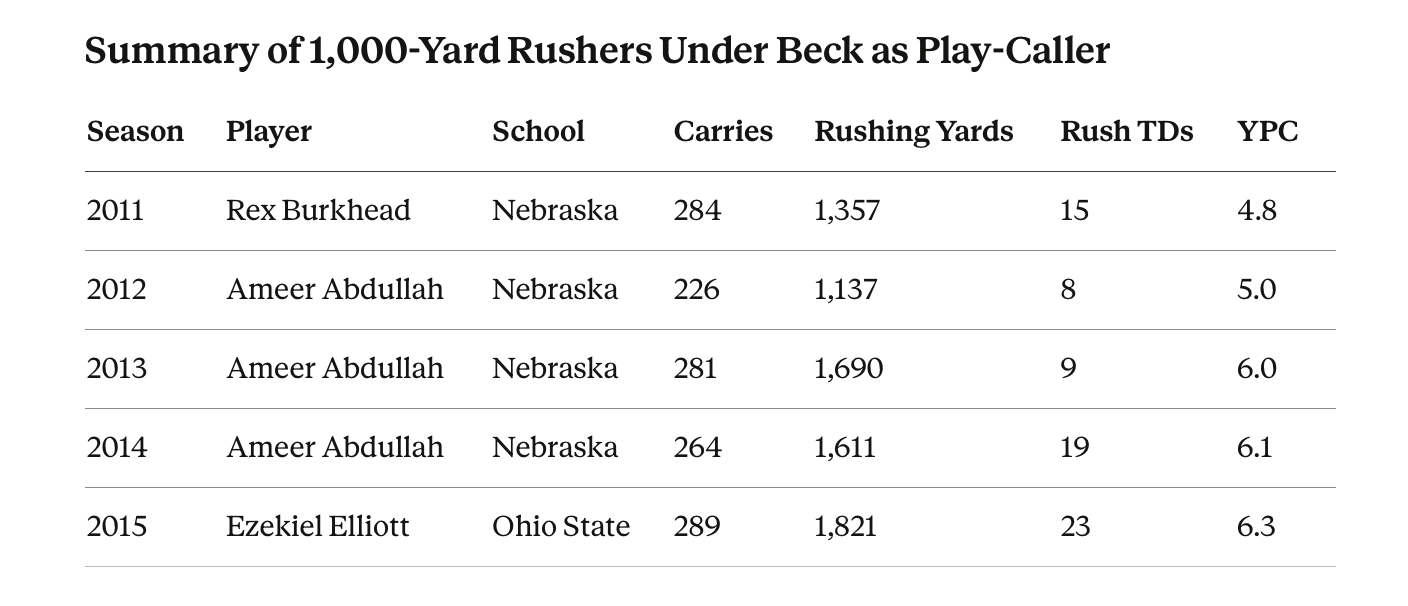
Now, in full disclosure I have asked Claude AI to retrieve and summarize the notable individual stat lines under Tim Beck during any role where he occupied play calling capacity. As with any AI tool, it is subject to making mistakes. Nonetheless, the info presented below should be correct.
Beck’s list of notable WRs is not as lengthy, including only two from the 2018 and 2023 seasons:

Every time I write an article I feel like I learn something new (and I hope you do too)—this time being the realization that Beck was a play caller for one of the most mythical CFF seasons ever via Ezekiel Elliott’s 2015 season. It’s a small world after all.
However, on the whole I must say that I’m not very impressed by Beck’s history. When you’ve been in the game as long as he has, it’s expected that there would be at least a few notable individual stat lines. Not having a 1000+ yard rusher since 2015 is a bit troubling given there have been nine full college football seasons since then.
Looking closer at Beck’s recent history, here is a table summarizing his 2018-2024 system characteristics:
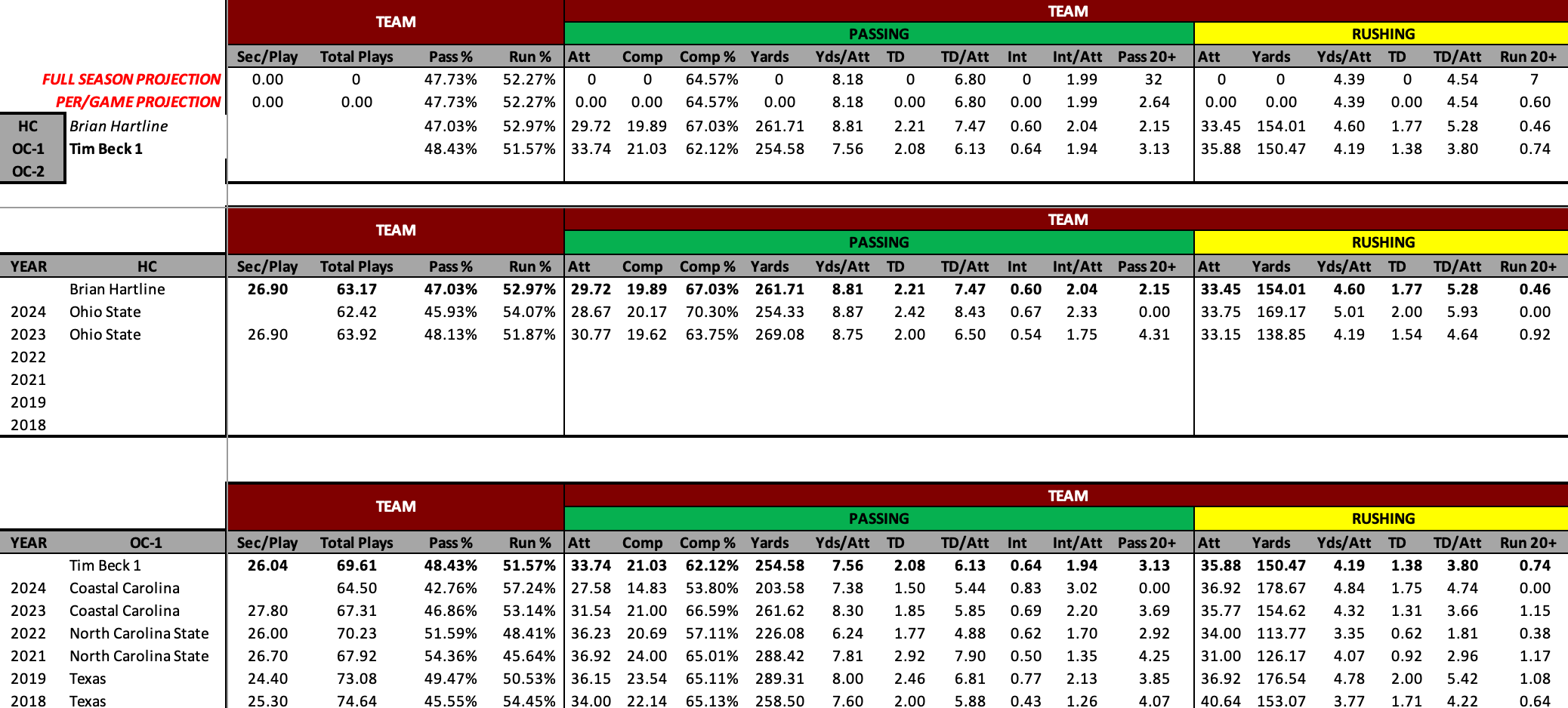
There is really nothing that stands out to me when looking at the above table. Beck runs a balanced system with a five-year average of around a 49/51 split towards running the football. The pace of his play calling is also quite average.
But I do think that coach Hartline will have a heavy influence in shaping the offence for 2026. Thus, I think there’s probably more than meets the eye here as far as how we should think about this offence and the possibilities it brings for CFF. It’s fair to say we just don’t know yet what a Hartline-run offence looks like when he has full creative control.
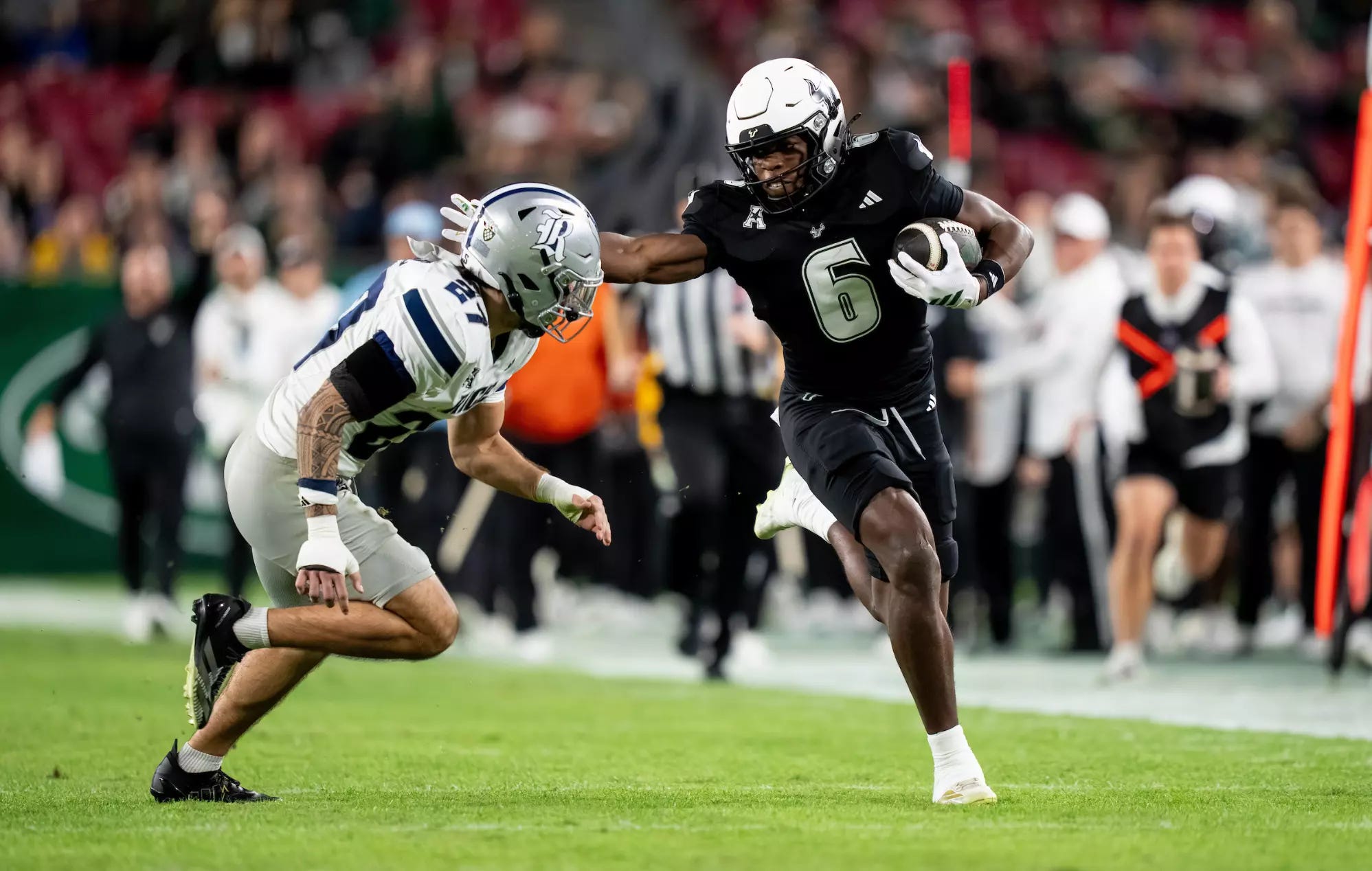
PERSONNEL
We’ve briefly touched on some of the notable names in the above sections but let’s dive deeper now.
Starting at QB, I view Van Buren and Kromenhoek as the primary competitors to start for the Bulls in 2026. Van Buren is coming off a 25-29 point performance (three passing TDs, 267 passing yards, 24 yards rushing) depending on the format vs. Houston in a bowl game. And while Bowl Game performances should generally be taken with a grain of salt, I do view Van Buren’s performance in that one as legitimate given that the Tigers didn’t even end up winning, and IIRC Houston had most—if not all—of their starters in.
It would be easy to write Kromenhoek off right there, but he’s had a very similar career to Van Buren thus far. In fact, he had an eerily similar performance in 2024 vs. Charleston Southern, where he threw three scores and 209 yards, and also ran in an additional 31 on the ground.
Obviously, it’s one thing to throw three scores against an FCS program in a blowout versus an SEC program in a bowl game. Neither are particularly ideal testing scenarios for assessing player performance, but the latter is definitely better.
The other two players rounding out the room are Jayden Bradford and KJ Cooper. Neither had done much in their careers thus far (you can see their career stats by clicking on their names).
RB is where things get really interesting. As mentioned in the C&S section above, there is a trail of occasional porcine usage under both play callers. However, the room is incredibly crowded at the moment and picking one out with the current info we have (or don’t have) is a fool’s errand.
Transfers into the room include Jason Collins, who was actually a bellcow at FCS program Morgan State in the seven games that he played in 2025, and another FCS bellcow in DJ Crowther from the Ivy League school Dartmouth.
Each player had multiple games where they received over 20 touches last season, but unlike Collins, Crowther held up better health-wise, appearing in 10 games. From what I can tell, Crowther missed the early part of the season, but then starting on Sept. 20 appeared in every game after that.
The most productive returner is Alvon Isaac, who rushed for 350 yards on 73 carries last season in a backup role. Chase Garnett is another name to know in the room as he was a freshman who appeared in two games last fall, taking a grand total of eight carries for 81 yards.
If I had to take a guess and choose a player, I would probably gravitate towards the most productive one in Crowther. However, at this point I don’t even think the coaches know who their best RB is, so any attempt to dissect the room is just idle speculation in my opinion.
At WR, I already mentioned several of the incoming names above, and many of them will be familiar names to some of the readers. Notably, Cameron Seldon was once upon a time a very highly-thought of player in C2C/Devy circles, arriving at Tennessee as a high four star ATH prospect. As far as I recall, he originally settled in at RB with the Vols, before transitioning to WR with Virginia Tech last offseason. He’s a player who may still just be scratching the surface of his athletic potential.
Another intriguing name is former Buckeye Bryson Rodgers. Obviously, OSU has virtually been un-matched in their acquisition of WR talent and development, so a player failing to break through there is not necessarily a death sentence for their NFL careers (see Jameson Williams). That being said, Rodgers really did basically nothing during his three years there. He leaves OSU with career totals of 11 receptions, 125 yards and one score.
While Rodgers was never one of the higher rated OSU WR recruits, he did have offers from places like Alabama, LSU, Texas and essentially the rest of the who’s who of CFB.
UTEP transfer Kenny Odom is by far the most productive player in USF’s WR room. In 2025, he caught 62 passes on 106 targets for 582 yards and six scores. Despite fewer targets (79) and receptions (46), he actually out-produced himself in 2024 with 741 yards and eight scores. He spent the previous two seasons in the FCS at Austin Peay.
Armani Winfield comes over after two seasons at each of Colorado State and Baylor. He’s had a forgettable career thus far, with his best season coming in 2024 (he caught 38 passes for 341 yards and two scores). Jaron Glover spent his last four seasons at each of the MSUs (at Michigan State from 2022-2024, Mississippi State in 2025). His career statistics are similar to Winfield’s.
Arhmad Branch is a similar commodity to the previous two names listed, transferring in from Purdue. Here’s a note from 247 Sports writer Chris Hummer on Branch’s move to USF:
A former four-star recruit with huge athletic upside, Branch was a favorite of several personnel staffers after the first few tiers of receivers [among transfer WRs].
Branch could have easily gone to the Power Four, but he wanted to play for Brian Hartline.
The most notable returning receiver is former Stanford Cardinal Mudia Reuben, who came on particularly strong for the Bulls at the end of 2025. He finished the year with a total of 495 yards and five scores on 36 receptions. Like many of the other players in the room, he’ll be entering his fifth year of CFB, which I think is notable in the sense that this USF WR group is extremely veteran, though maybe not very experienced in a lot of cases.
All in all, it’s not hard for one to envision a scenario where all three major positions feature a CFF relevant player in 2026. At the same time, there could just as easily be zero CFF relevant commodities from this club in 2026 given how crowded each room is, and the questions we have about the philosophy of touch distribution from the staff.
However, of all the positions groups, I do feel strongly that the WR position will feature at least one player that is worthwhile in most CFF leagues. It’ll be interesting to follow the offseason updates out of camp for this program, and of course, I’ve got you covered here at VP. USF, in my opinion, may be the most interesting program in all of CFB this offseason. ◾
If you enjoyed this content and would like to read more, I recommend joining the Pigpen, a community of thousands of degenerate college football fans:
Sample from 2018-2024, excluding 2020.